
Let’s finish our discussion (for now) about getting lots of practice with fundamental movement patterns by recognizing where they’re used in different exercises.
So far I’ve covered shoulder packing and torso bracing, and I’ve used swings and get-ups to show how they’re applied.
This week’s fundamental is hip hinging. But since it should be fairly obvious how hinging applies to swings—see lift with your legs, not with your back and hinging too early if it’s not — I’m going to spend more time showing how it applies to the get-up. In fact, practicing this one small piece of the get-up will actually improve your ability to swing (or clean, snatch, or deadlift) because it’s effectively the same movement.
So if you’ve been avoiding other “hinging exercises” for fear or past experience of back pain (which means you’re probably doing something incorrectly), this is a great way to learn and improve the movement pattern in a safer-feeling scenario.
And if you’re new to these tips or want to review why we all should be doing get-ups in the first place, you can read more details here.
Hand, knee, and feet positions
A generally foolproof way to practice hinging in the get-up is by finding a specific position with the non-working hand, knee, and both feet on the way up and down.
Check out the following pairs of images to see good and not-so-good positions:
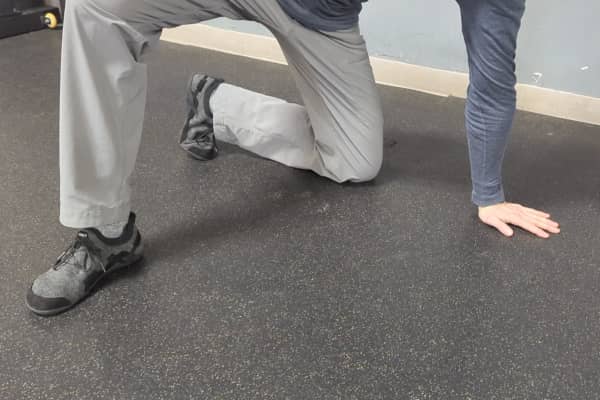
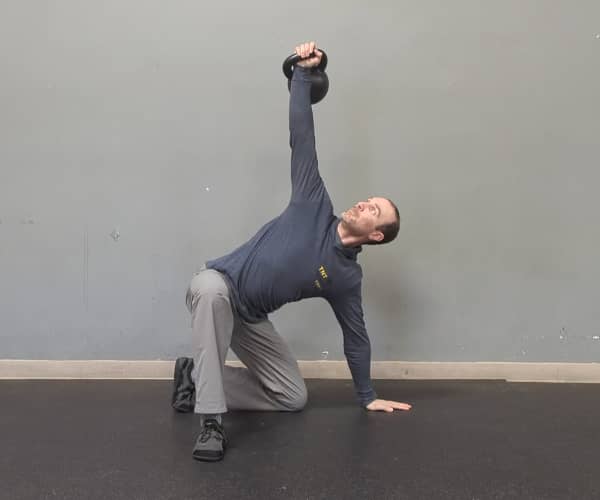
In the two images above, notice the “triangle” between the right foot, left knee, and right hand as well as how a straight line drawn through the left foot and knee would also pass directly through the hand.
Compared to a lunge position (see below), this “opens” the hips and effectively forces them to hinge. This is the good position that you want to find on both the way up and down.
(On another note, also notice the straight line from the tailbone through the crown of the head in the second image above. This is the torso brace from last week’s tip. Everything works together to make you safer and stronger!)
And, now, onto some not-so-good positions…
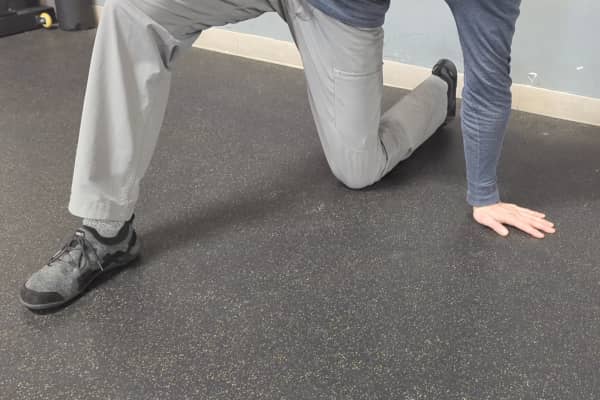
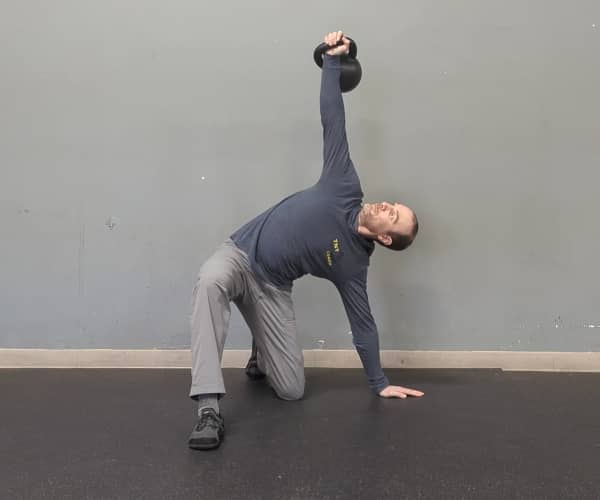
In the two images above, a triangle could still be drawn between the right foot, left knee, and left hand. However, the position of the left foot makes all the difference in this case. Notice how a line drawn from the foot through the knee would not pass through the hand.
Because a line from the left (back) foot through the left knee still generally lines up with the right (front) foot, the hips remain in a “closed” position. This is good for locomotion (i.e. walking, running, lunging) but requires side flexion of the spine in order for the hand to reach the ground.
As mentioned in various past tips, spine flexion, extension, and rotation is great when we’re stretching. But it’s an invitation to injury when we’re “loaded” (i.e. lifting something). So we obviously don’t want to do it during the get-up.
And that leads me to the second not-so-good position:
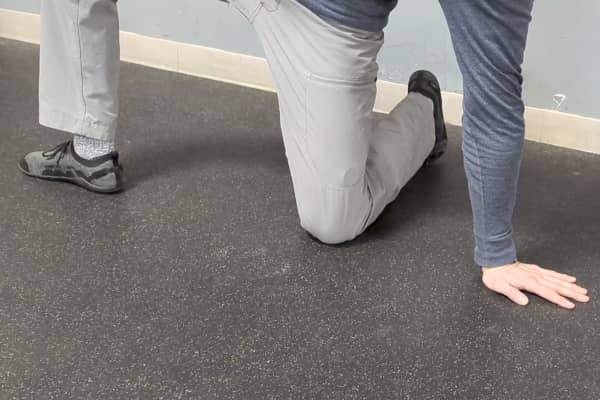
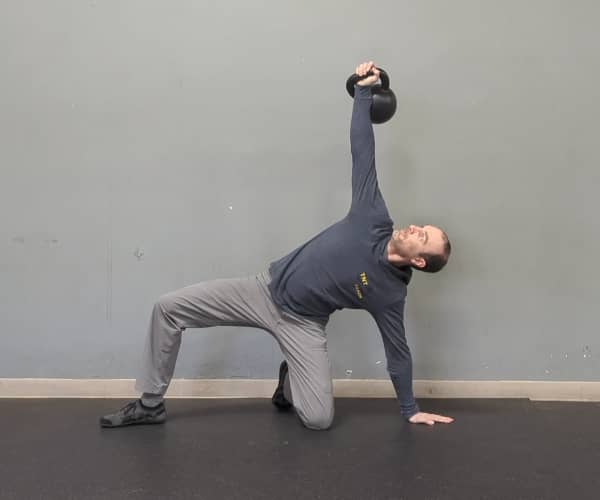
This one is a bit sneaky because the feet and knee end up in the correct positions, but the hand is in the wrong spot. That is, a line drawn from the left foot through the left knee would again not pass through the hand.
As you can see in the first image immediately above, this has caused the “triangle” to disappear. In its place is the straight line that should exist between the hand, knee, and other foot.
And once again, this leads to the spine side flexion that we don’t want.
The get-up and the swing
Hopefully you’re able to see how the good position above is similar to that found in swings (or cleans, snatches, or deadlifts). But if not, let’s clear that up!
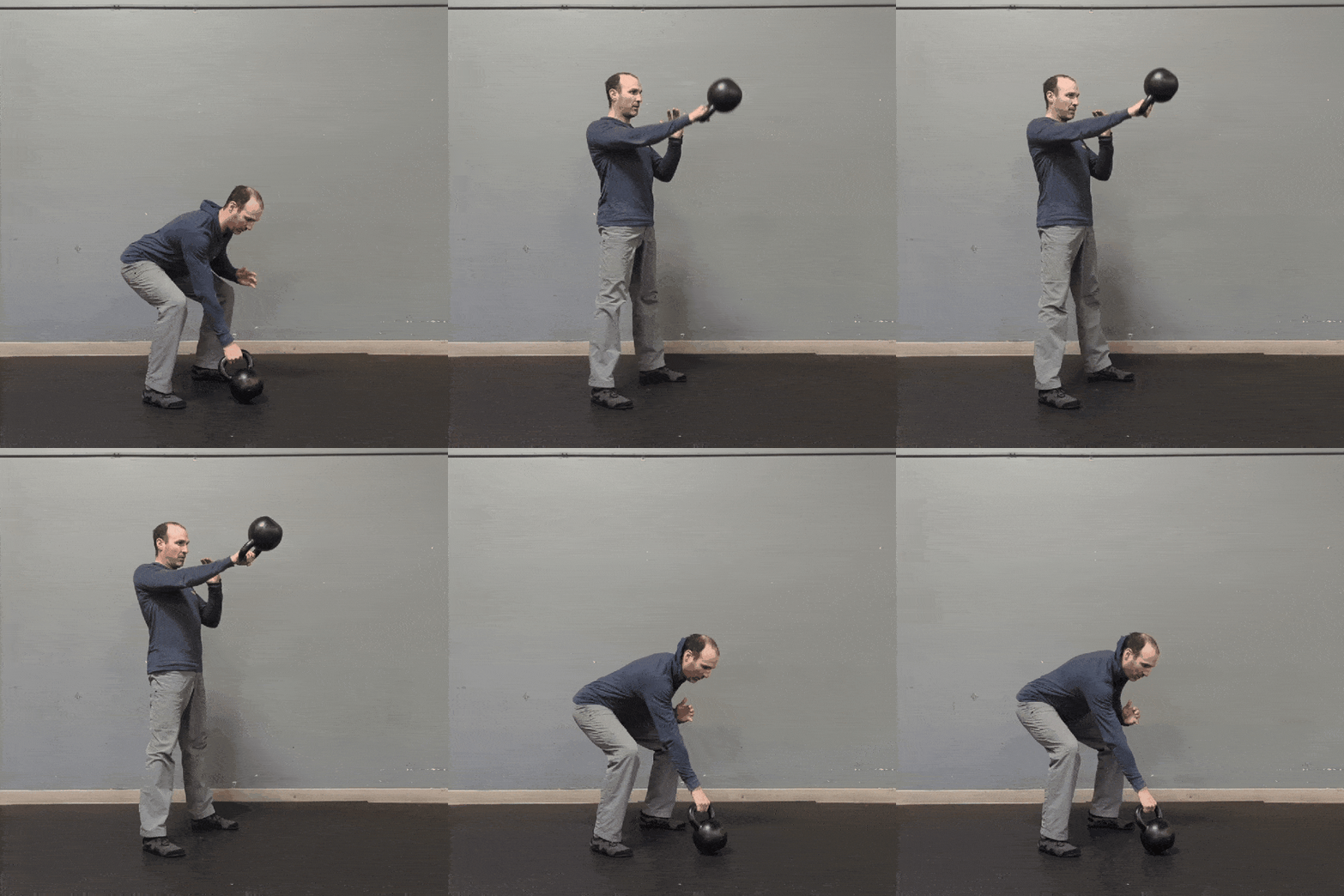
First take a look at the one-hand swing, and notice the hip hinge (and packed shoulders and torso brace)…
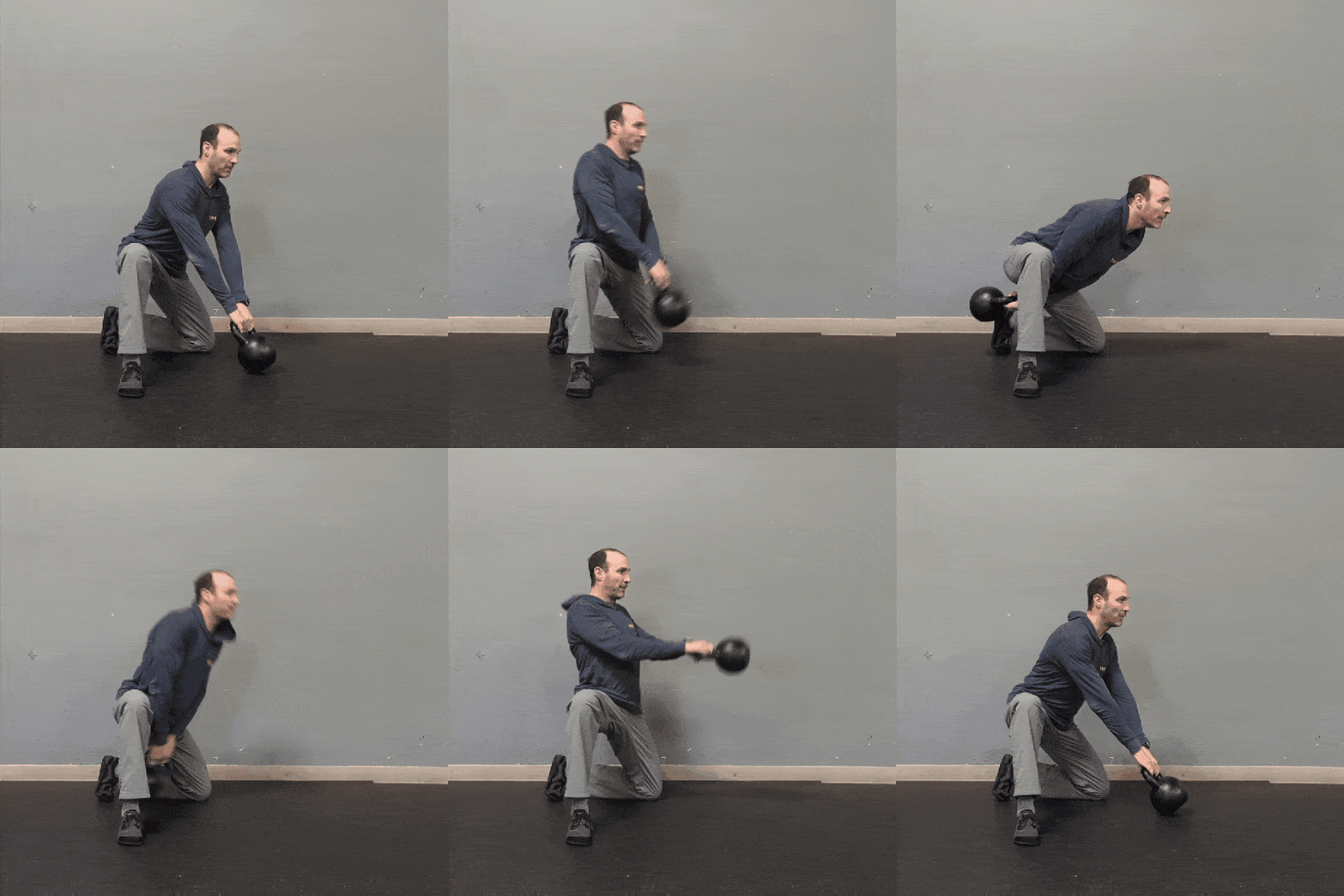
And compare that to these half-kneeling swings…
And finally the related position of the get-up…
Take those half-kneeling swings to the feet, and you have, well, swings. Take the kettlebell and put it overhead while the other hand finds the floor, and you have a get-up.
And that is why practicing the get-up will improve your hinge.
Putting it into practice
This week when you do get-ups, pay special attention to your leg and hand positions on both the way up and the way down. (And if you weren’t planning to do get-ups this week, what are you waiting for?!? Again, read why we should do them regularly and forever(!), and add them! 😉💪)
Is your general tendency to hinge your hips or bend your spine?
If it’s the former, carry on.
If it’s the latter, spend some time practicing (without any additional weight) moving between steps 4, 5, and 6 from the previous tip linked above. When you can comfortably, confidently, and consistently find the “triangle” position with your hand, knee, and feet, repeat the process with some added weight. (Note that that might not be in a single training session!)
Last but not least, any time you do get-ups or swings going forward remember to focus on not only hinging your hips but also maintaining a braced torso and packed shoulder(s). Before long you’ll begin to notice similarities between other exercises and, more importantly, improvements to your everyday capabilities.
That’s when training really becomes fun.