
A few weeks ago someone asked me what exercise I thought everyone should be doing.
My initial reaction to that question was: It depends. After all, we each have different interests, abilities, restrictions, and goals; and there are a solid handful of exercises that have numerous benefits and which cover multiple basic human movements. So it only makes sense that each of us would benefit the most from doing one of a variety of exercises that best fulfilled our individual needs.
But as I considered the question longer, I realized that there is one exercise which I’d include, in whole or in part, in any program because of its versatility, benefits, and potential to positively affect a variety of goals. That exercise is the Turkish Getup—or simply getup or TGU.
Versatility
Many exercises are versatile. That is, they can be used in a host of programs to improve a variety of conditions: strength, endurance, mobility, and more.
But get-ups take that versatility to the extreme. You can:
- Use heavy weights and low reps per set to build strength. Even single reps include a lot of “time under tension”, a requirement for both strength and muscle growth.
- Use moderate to heavy weights and low reps for lots of sets to build muscle and improve cardiovascular endurance without excessively fatiguing any single muscle group.
- Use light weights and high reps per set to increase local muscular endurance.
- Use light weights and low reps per set to evaluate or correct imbalances or restrictions between sides.
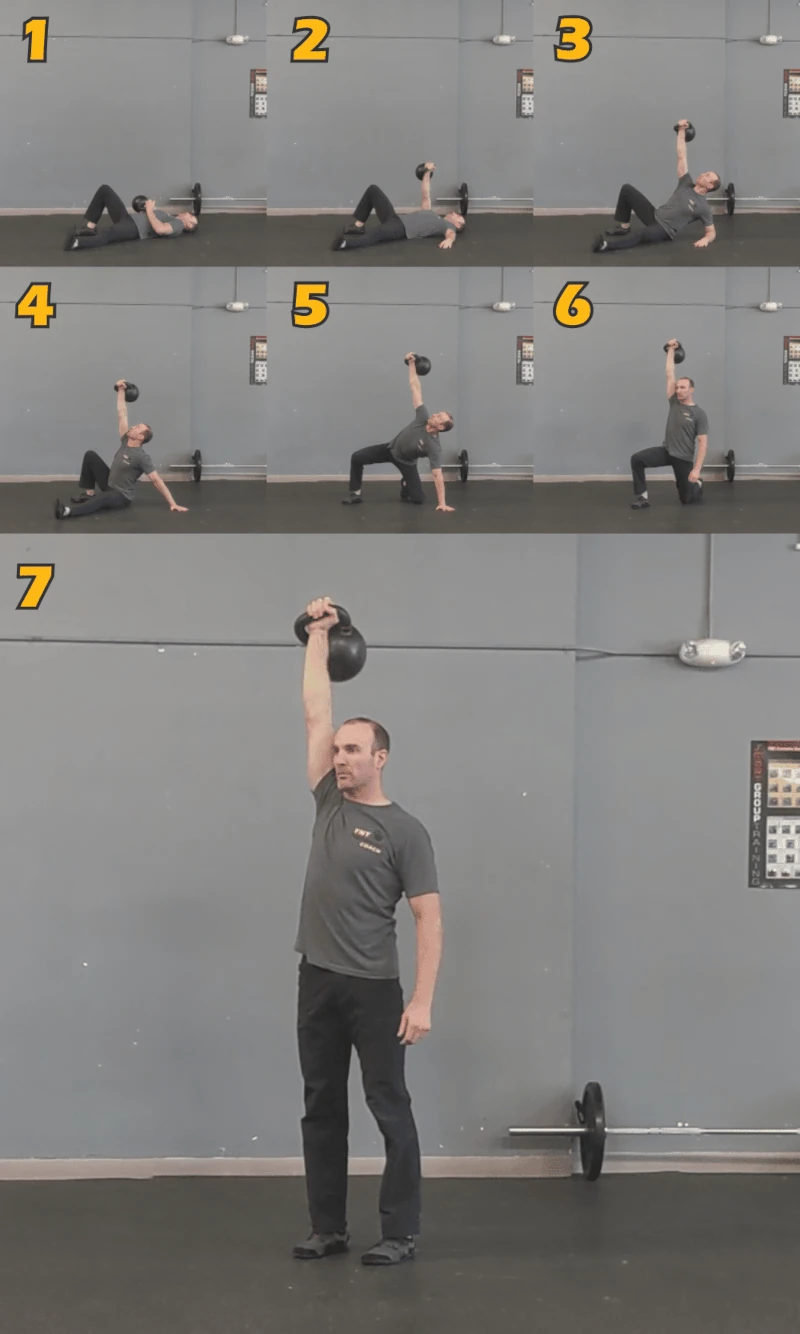
- Perform repeated partial reps to emphasize a particular muscle group or movement pattern:
- Position 1 → 2 (using the numbers above) for arms, shoulders, and an upper body pushing movement
- Position 2 → 3 for abs, obliques, and rotational movement
- Position 3, 4, & 3 → 4 for improving thoracic spine mobility (middle of the back where we tend to “round” from sitting too much)
- Position 5 → 6 for abs, obliques, glutes, and to practice your hip-hinge
- Position 6 → 7 for legs
- Position 1 → 7 for improving shoulder stability & resiliency
- Perform partial or full get-ups to warm up for other lifts.
- Perform partial or full get-ups to stretch or “open up” after doing heavy pulling movements (like pull-ups, cleans, snatches, or deadlifts).
- Place a glass of beer on your fist and do the get-up as a party trick. Hey, we can’t be serious all the time, right?!?
Benefits
Besides the benefits listed above, perhaps the greatest benefit of doing get-ups regularly is something that is (or should be) important to us all: aging gracefully.
There is a single movement that most of us do at least once (often more than once) almost every single day of our lives from the time we can walk until the last day that we do walk: getting up from the ground/bed/sofa.
If you play with your kid, grandkid, or pet; if you ever pick up anything that gets knocked off a counter; if you slip on ice; if you sleep in a horizontal position, then you get up.
And there’s no better way to practice getting up than by, well, actually getting up. Doing it with weight just makes it (and us) better! 😉
Affecting other goals
Get-ups can be used as the main or a complementary exercise in programs with a variety of desired outcomes including strength, cardiovascular endurance, hypertrophy (muscle growth), and body re-composition (along with diet improvements).
But they also can produce some interesting “what the Hell” effects. These are results that you wouldn’t initially expect to see based on what an exercise does or how it was used in a program. A couple examples include improvements to bench pressing strength and pull-up endurance. I wouldn’t be surprised to hear if you experienced others.
Putting it into practice
If get-ups aren’t currently part of your training routine, consider getting at least one formal lesson and adding them to one or more training sessions per week. Even if you’re unable to perform a complete repetition or use anything heavier than a shoe, you’ll still experience some positive improvements as time passes.
If you already include get-ups in your routine, that’s excellent! Try adding in a single rep per side once per week with the heaviest weight you can do safely. You’ll be surprised at how quickly you’ll notice it getting lighter (among other potential improvements)!