
In last week’s tip I mentioned my preference for keeping my mobility practices efficient by utilizing drills that target numerous areas. Two of my three favorite drills that fall into that category have already been the subject of past tips. This week’s tip covers the third: the T-spine Bridge.
(If you missed the first two, check out the Brettzel and the Tactical Frog.)
In a way, the T-spine Bridge is similar to the Brettzel in that it targets the hips and thoracic spine (mid-back), two areas that most people typically find need the most work. But the drills work in a sort of complementary fashion.
When performing the Brettzel, the bottom hip and the top shoulder are rotated away from each other. (See the Brettzel tip for specific details.) When performing the T-Spine Bridge, the corresponding hip and shoulder are rotated toward each other.
That might not seem like a big difference, but the two drills will feel quite different in practice. Let’s take a look at the details to see what I mean.
The T-spine Bridge
Performing the T-spine Bridge requires three simple steps.
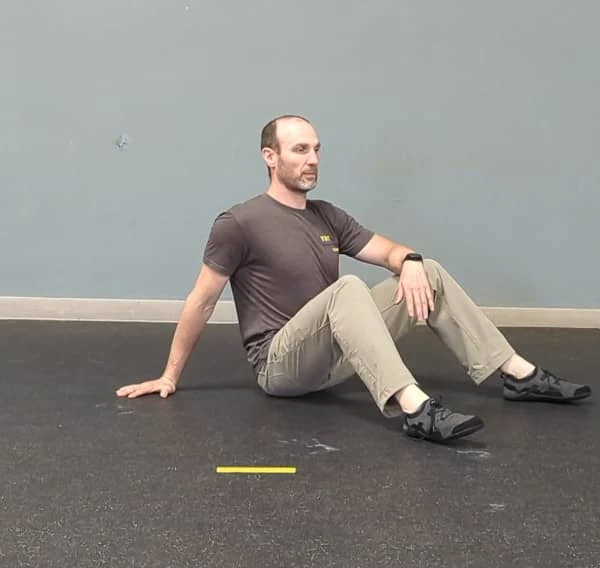
Begin by sitting upright on the floor with your feet shoulder-width apart, both knees bent to about 90 degrees, and one hand 6-12 inches away from your hip.
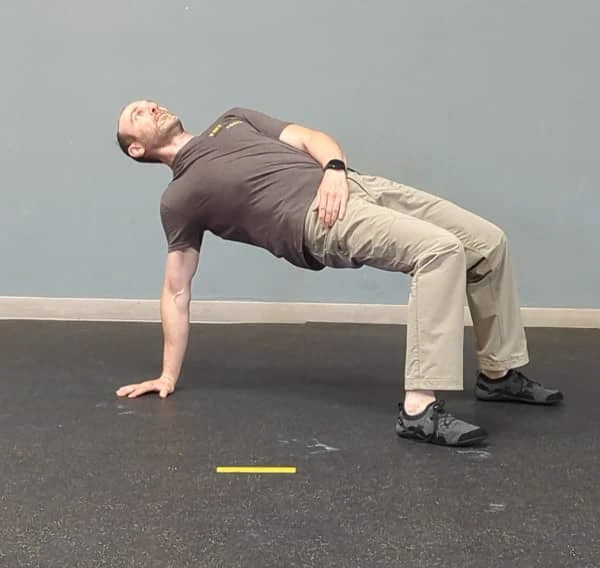
Next, raise your hips as high as possible toward the ceiling, keeping them as level as possible. (More on that in a minute.)
Finally, rotate your torso toward the posting arm and reach across your body with your free hand.
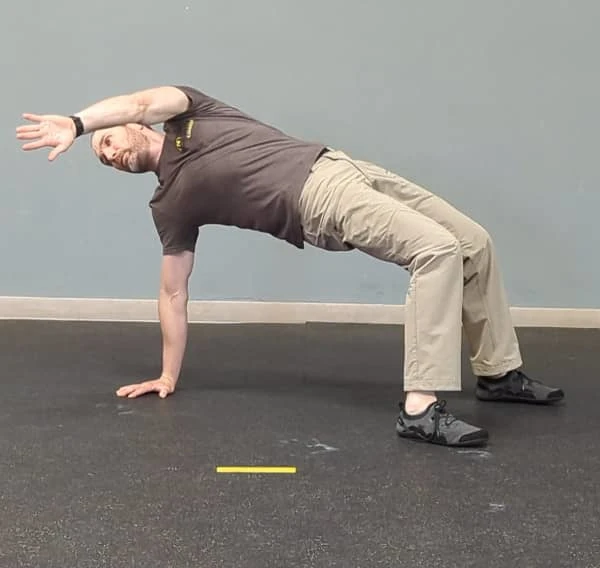
If you’ve done the drill correctly, you’ll feel a lot of tension in the lat (upper back below the shoulder) on the same side as the posting arm as well as a stretch in the front of the same-side hip. It should basically feel as if you were wringing out your torso like a wet towel. While stretching your hip. 😁
If that’s not what you feel, one of the following three issues is the likely culprit.
Common T-spine Bridge mistakes
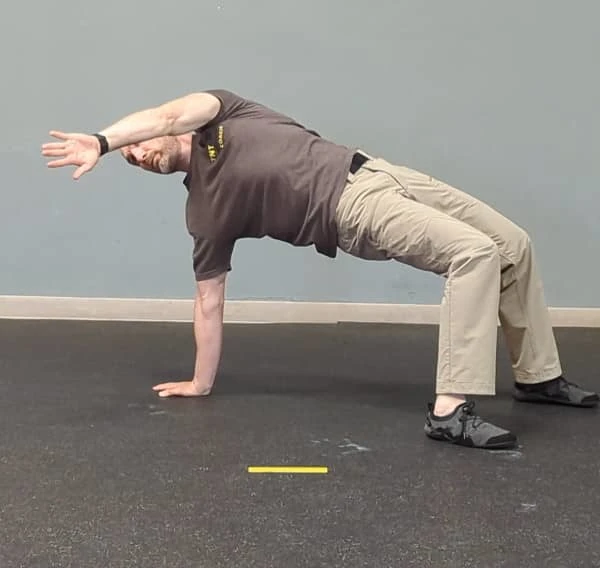
The first mistake is quite subtle but makes a huge difference for lat contraction and, by extension, shoulder safety on the posting side: the posting arm is excessively externally rotated.
The simplest way to recognize if you’re doing this is to look where the fingers of your posting hand are pointing. If they’re aimed directly opposite of your feet, as in the pic below, you’re in the incorrect position. (Note the difference in position of the posting hand’s fingers in the pic below as compared to that of any other pic in this tip.)
To fix the mistake, start again at step one, this time making sure your fingers are pointed 90 degrees away from your hip.
The second mistake is easier to spot and to fix: the free hand is reaching over the head as opposed to across the body.
If you’re making this error, you’re probably not rotating your torso as much as you could and possibly arching your lower back more than or instead of fully extending your hips.
To fix it, simply “lower” the arm by reaching across your torso instead of over your head. Then really emphasize the reach by trying to touch the closest wall.
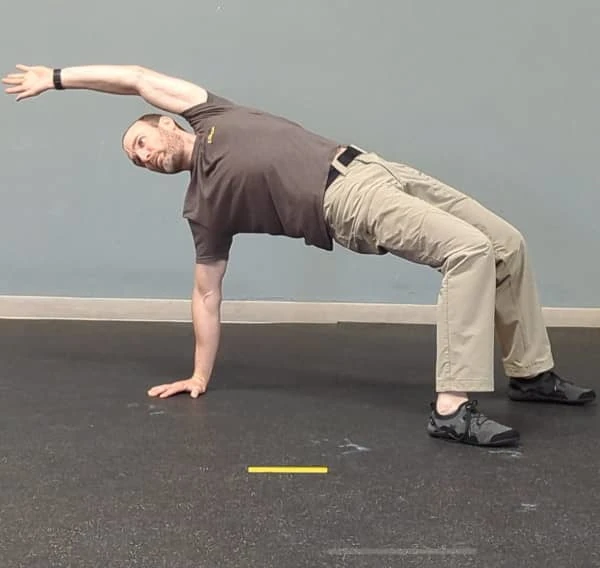
The final mistake is also easy to spot but sometimes harder to fix: the posting side hip is lower than the opposite hip.
This happens either if your hips or thighs are tight or if you’re emphasizing the torso rotation too much and the hip elevation/extension too little.
To solve the issue, first try rotating your torso slightly less while driving the posting side’s heel into the ground. If that doesn’t make much difference, stretch your hips with this drill or (ahem, and) the Brettzel. Then try the T-spine Bridge again.
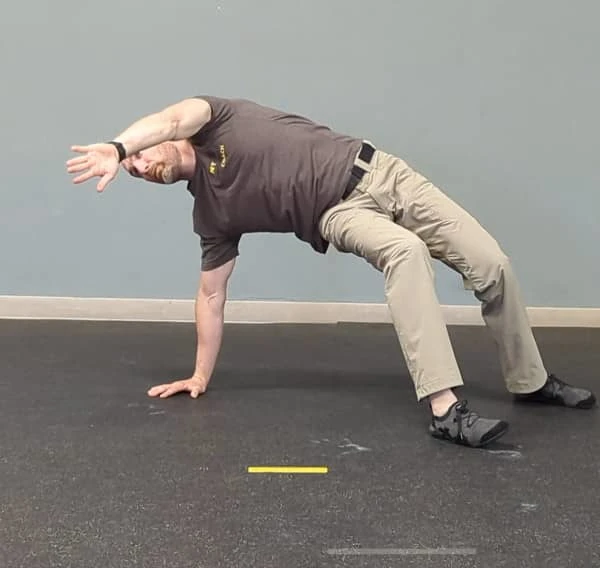
Putting it into practice
Especially if you spend much of your day at a desk, alternating between sets of Brettzels and T-spine Bridges for 3-5 minutes in the morning or (ahem, and) evening could do wonders for your posture.
And adding either or both drills to the warm-up time of your strength training sessions, particularly before upper body work, should make you feel quite spry.
So give them a try. Their efficiency will win you over, even if you’re not a fan of mobility work.