
In last week’s tip, I answered a common question about where your knees should end up when squatting. This week’s tip covers another similar and common question about a different exercise: “Where should my hands go when doing a push-up?”
As with many fitness-related questions, there’s (unfortunately) more than one answer. In this case, I’ll suggest that there are three:
- Under your shoulders or ever-so-slightly wider.
- It depends on your goal, although not necessarily how you might expect.
- It doesn’t matter; what you do with your elbows is more important.
Let’s briefly review some details behind each answer so you can find the best hand (and elbow) position for your push-ups.
Hands under the shoulders
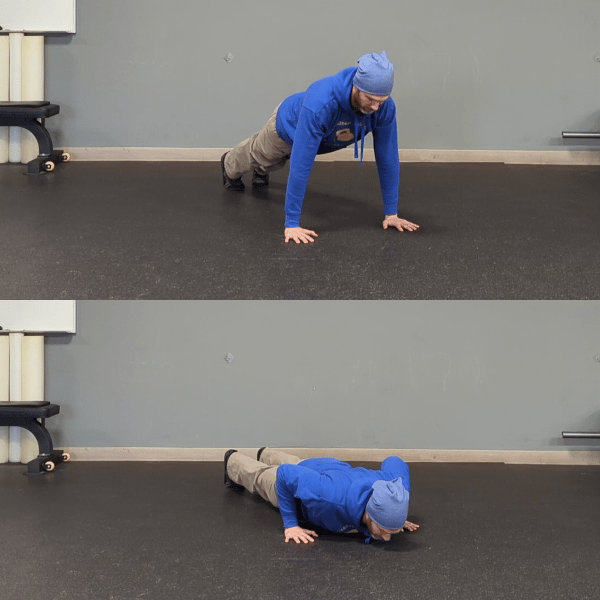
This is obviously the simplest answer, so I won’t make it any more complicated. Placing your hands directly under the shoulders is generally the safest and strongest hand position.
Especially if you’re in the early stages of practicing push-ups, this is where you should begin. And even when you’re more advanced, it’s still a perfect baseline position.
(My thumbs are under my shoulders in the pic below, which puts my hands just wider than shoulder width. Your specific position may vary slightly.)
Hands wider than the shoulders
It’s easy to find commentary on the Internet about how wide-stance push-ups target the pecs (chest muscles), narrow-stance push-ups target the triceps (backs of the arms), and doing different variations is—enter my best Monster truck announcer voice—”the best way to get your upper body jacked”.
I’m not here to argue the pros and cons of “getting jacked”. But I will suggest that a more useful reason for choosing a specific hand position than (minimal) variations in muscle growth is difficulty.
Because the elbows experience less flexion at the bottom of push-ups performed with a wider stance than with a narrower stance, the former tends to be slightly easier. This is why people who are newer to doing push-ups generally (often subconsciously) opt for a wider hand position.
Although a shoulder-width stance is still arguably slightly safer, a wider stance is a valid option if you’re not yet a push-up pro.
Hands narrower than the shoulders
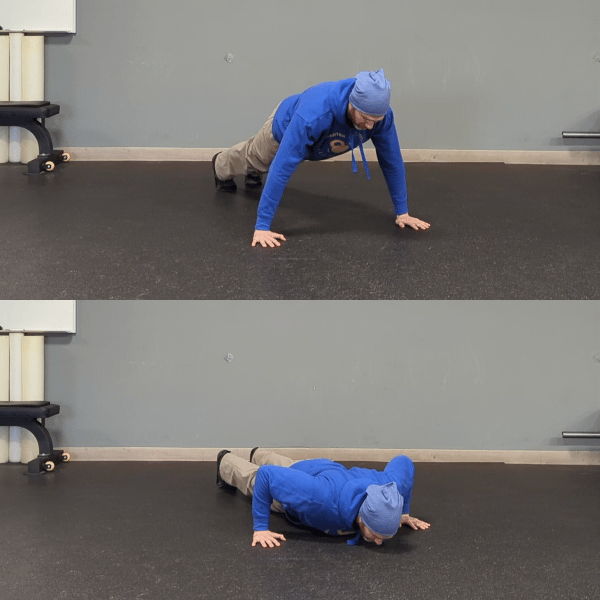
Alternatively, if your push-up game is strong and you want a new progression, then a narrower hand position is the better option. The greater degree of elbow flexion will not only require and develop more strength, but it will also start you along the path toward mastering the one-arm variety (which requires a similarly high degree of elbow flexion).
That said, there’s an even more important factor than the width of your hands for performing safe (and subsequently effective) push-ups.
Be aware of your elbows
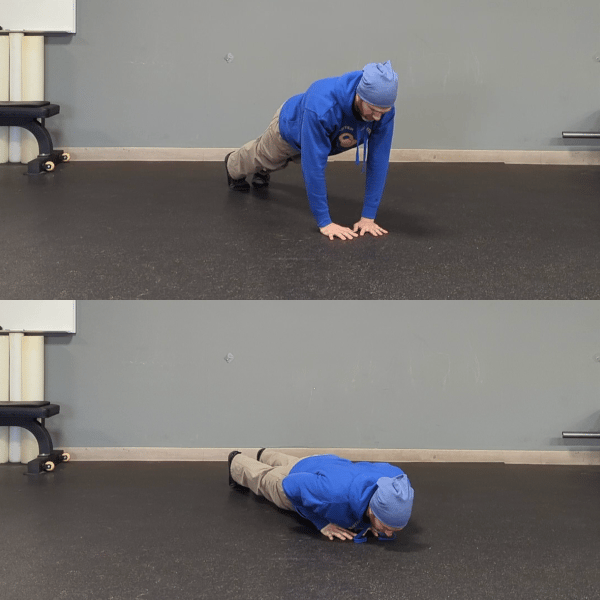
The most common push-up mistake I see is the “elbow flare”. This occurs when the elbows track significantly wider than the hands at the bottom of the exercise.
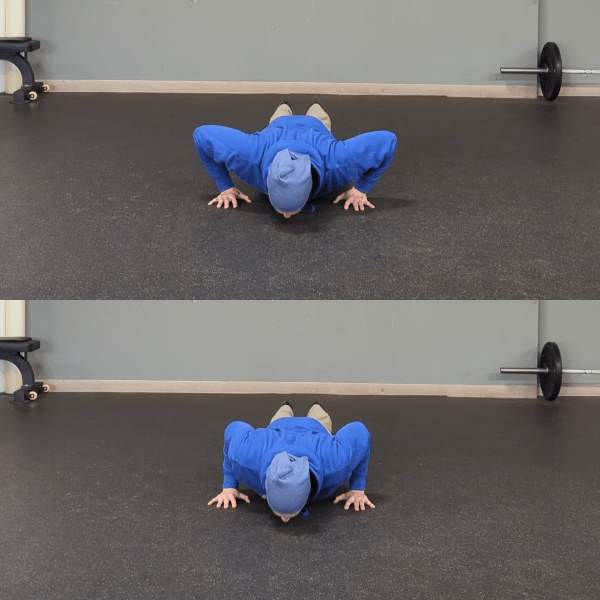
It can happen in almost any type of stance but is extremely common when the hands are too far forward.
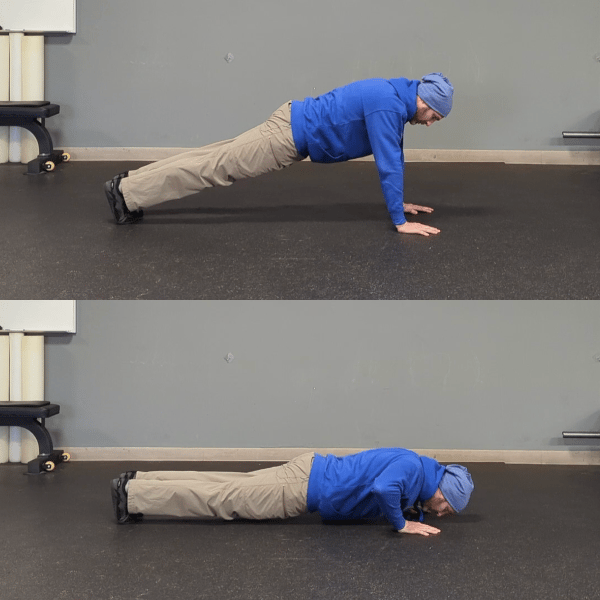
Notice how my fingers are under my face at the top of the pushup position in the top image above. This can exacerbate elbow flare at the bottom position, as shown in the bottom image.
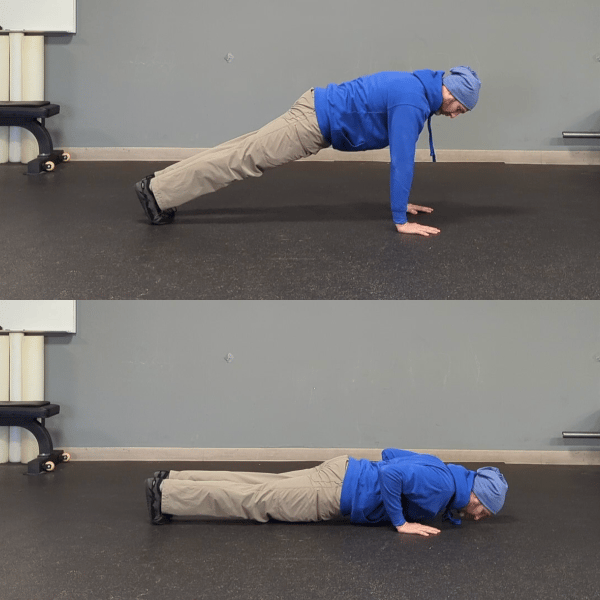
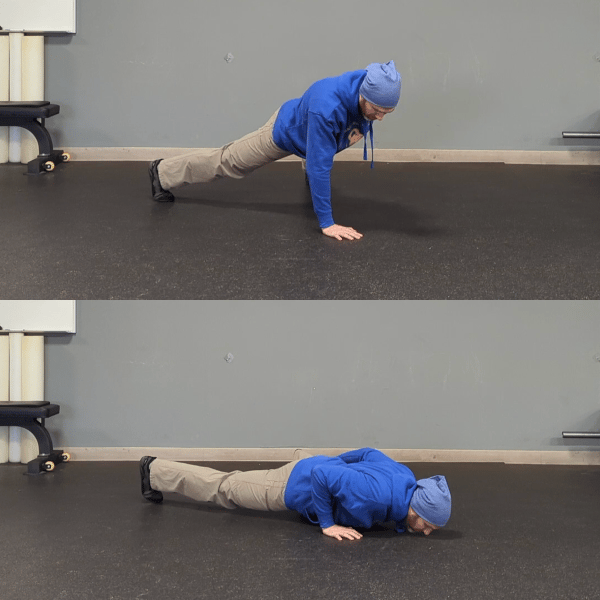
Keeping the palms even with the shoulders sets up a better elbow position at the bottom, as shown in the images above.
In any case, flaring elbows put a lot of strain on the shoulders (not in a good way) and should be avoided.
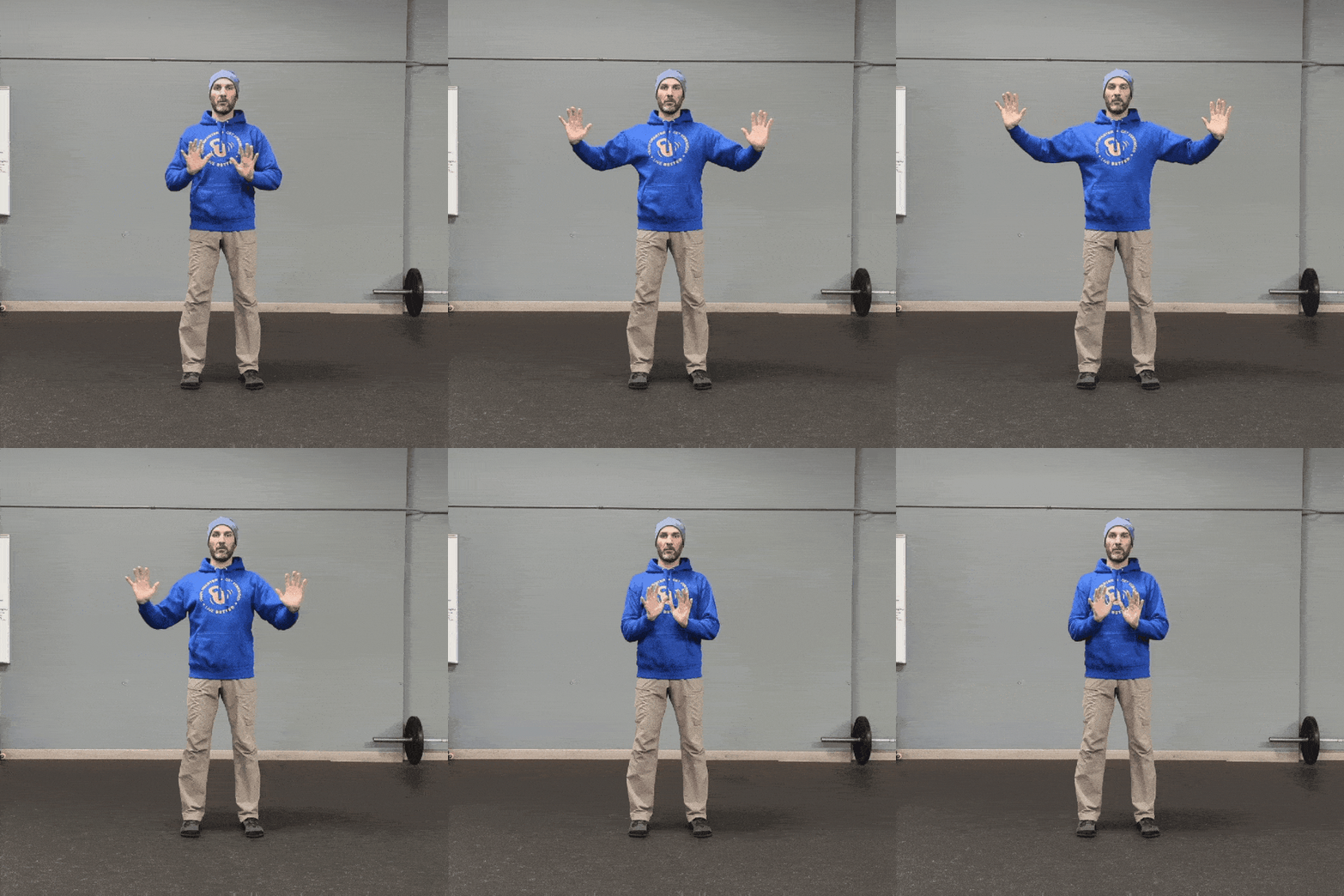
A safer and stronger movement happens when the elbows roughly track the width of the hands. That is, when the hands are narrower, the elbows should be close to (or brush) the torso at the bottom. As the hand stance becomes wider, the elbows should gradually move away from the body.
You can visualize this, from a standing position, as how you’d catch a ball of various sizes (i.e. a basketball on the narrower end and one of those big, inflatable exercise balls on the wider end).
Putting it into practice
The finer details of push-ups (and planks) are easy to overlook because the exercises themselves seem so simple.
But paying attention to the finer details can have profound effects, from reducing or preventing injuries to improving results to simply making the movements feel better and, subsequently, more enjoyable to do.
So the next time you find push-ups in your training plan, consider spending some time playing around with different hand positions to find what works best for your current capabilities. And whatever position you land on, make sure your elbows follow suit.