
Over the past week I’ve had two private sessions, with two different people, that both included kettlebell swing practice. And both people asked some version of the same question:
How much should I bend my knees at the bottom?
It’s a good (and common) question. Most people who have learned a little about swings know that a swing is a hinge, and many take that to mean bending mostly at the hips while keeping the knees almost straight. I’ve even described the knees in a hinge as bending “slightly” myself (in this tip about the difference between hinges and squats). While that’s valid in such a comparison, “slightly” leaves a lot of room for interpretation. And in a swing, where you land within that range makes a real difference in both safety and effectiveness.
Three different elevations
Here’s the guideline I use: at the bottom of the swing, your shoulders, hips, and knees should be at three different heights. Shoulders higher than hips, and hips higher than knees.
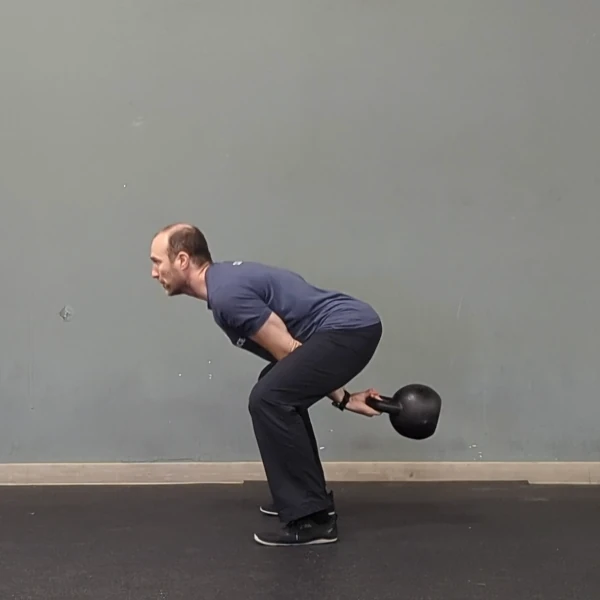
Those heights are approximate and will vary by individual. Longer tibias (lower leg), femurs (upper leg), or torso will slightly shift the angles between them, so there’s no need to break out a protractor to measure precisely. What matters is that there’s a visible difference between each.
If the position looks familiar, it should. It’s very close to the bottom of a vertical or broad jump, right before you take off. When we load up to jump as high or far as possible, we naturally end up with our shoulders, hips, and knees at three different heights, not with two of them level. It’s the position our bodies already use to produce power.
The easiest way to see why it matters is to look at what happens when two of them end up at about the same height.
Shoulders and hips level: the sippy-bird swing
If your shoulders drop to roughly the height of your hips, you end up looking like one of those drinking-bird toys dipping its beak into a glass of water.
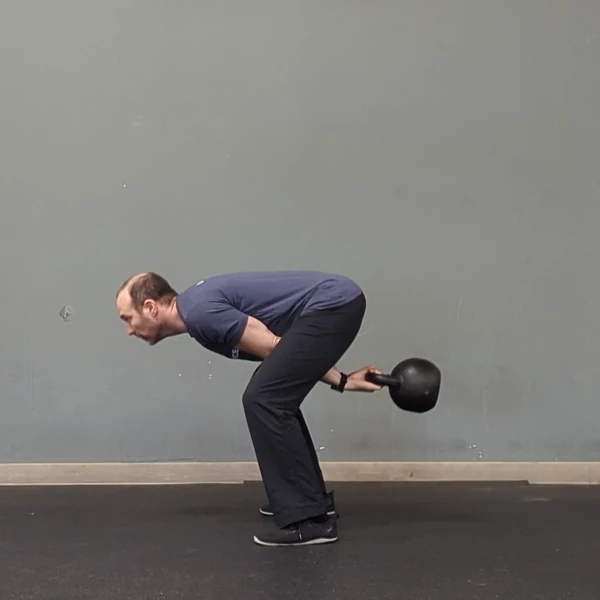
When the knees stay mostly straight, the hips drop minimally and instead move mostly backward on the downswing. That’s not necessarily a problem in and of itself. But it does mean that they then move mostly forward on the upswing, which makes it easy to hyperextend your lower back either at the top of the swing or right as the upswing begins.
Hips and knees level: the squatty swing
Go the other direction by bending your knees too much, and your hips will drop to about knee height, which is basically a squat.
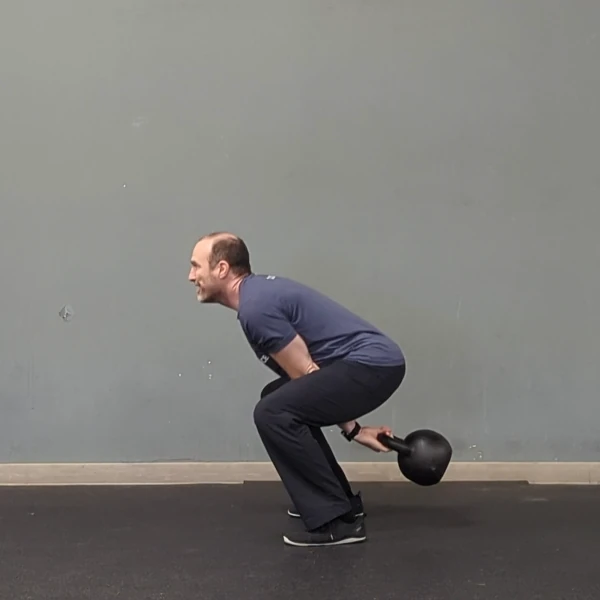
Of course, squatting is a natural human movement, and intentionally doing squats is great. Squatty swings, however, are not, because the direction that the bell travels on the downswing in relation to your torso puts extra strain on your spine at the bottom of the swing. (With the torso more upright, the bell applies force somewhat more perpendicular to your spine than parallel to it.)
Finding the middle
The cue I use to improve either type of swing is the same, just flipped. If your swing is sippy, I’ll ask you to “squat more.” If it’s squatty, I’ll ask you to “squat less.”
Now that doesn’t mean I want you to actually squat (or not squat). But the squat is such a familiar pattern (we all sit more than we should) that it makes an easy reference point. Aiming a little toward it or away from it lands people in a better position more often than not.
Putting it into practice
If you already swing: Record a few swings from the side. Then review the video, and pause it at the bottom of a swing to check the three heights:
- Are your shoulders and hips roughly level? If so, think “squat more” on your next set.
- Are your hips and knees roughly level? If so, think “squat less.”
Then immediately perform another set (recording that one too). If you successfully make the change, you can expect it to feel like too much because it’s a position you’re not used to yet. Check the video to see how it looks, and either make further changes, if necessary, or try to repeat what you just did. (If you’re anything like either of the gentlemen from my private sessions, even a little bit of practice should make your swings feel easier, stronger, and more compact/powerful.)
If you already have three elevations: Use the same video to check your timing. Note where the bell passes between your legs on the downswing; if it’s below your knees, you can squeeze a little more benefit from your swings (and make them safer) by delaying when your hinge begins.
If you don’t swing yet: Start with some hinge and squat drills so you can feel the difference between the two. Then, ideally, consider taking a lesson or attending a workshop to get started on the right foot.