
Today I’m taking a one-tip interlude from the aforementioned summer recipes series to share a quick story about my experience from the Grand Canyon trip (mentioned in that linked tip) and how it relates to why I really train.
If you didn’t realize that you could hike across the Grand Canyon, well, you can. There are actually a couple routes up/down the more heavily visited South Rim, all of which converge into a single trail on the north side.
We started on the North Rim just after midnight, descended roughly 5600 ft on the North Kaibab Trail (7-8 miles), followed the trail along the Colorado River (7-8 miles), and then headed up 4700 ft on the South Kaibab Trail (6-7 miles) to finish on the South Rim at just after 2 PM.
Everything went smoothly for the first 16-17 miles before becoming somewhat more “interesting” during the latter part of the final stretch.
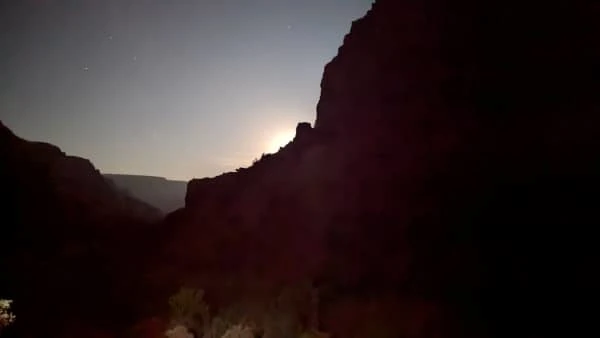
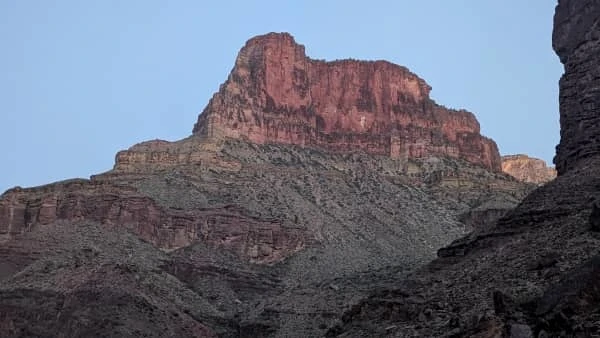
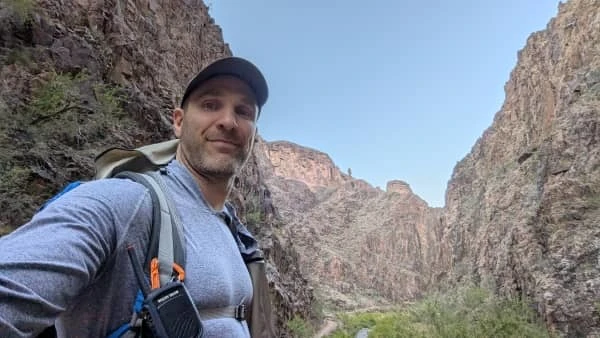
Of course, we fairly accurately accounted for the distance, heat, and water logistics. But the one factor we ended up overlooking was altitude. (When you’re hiking up into the mountains, altitude seems obvious. But when you’re hiking down into a canyon, it seems like less of a concern… that is, until you have to hike back out!)
Only one person in our group currently lives in a location where she could routinely train above 5000 ft. The rest of us came in the prior day from altitudes lower than 1000 ft. And the North and South Rims of the canyon are over 8000 and 7000 feet above sea level, respectively.
To keep the story brief, one friend (who was in otherwise great shape) really struggled with the combination of altitude and heat. While she was a trooper for the final four miles, we decided that the best and fastest way to get her up the final switchbacks to shade, A/C, cool water, and rest was to carry her.
So after hiking just over 21.5 miles and just under 10k feet of elevation change, my brother and I took turns piggyback carrying her up most of the last 100 vertical feet of the canyon.

And that finally leads me to why I really train (i.e. exercise) the way that I do.
Of course, I’d be lying if I didn’t say that I appreciate the health and aesthetic benefits that training provides (although I can honestly say that those reasons rarely motivate me to get off my butt when I don’t feel like doing so). And as I’ve previously mentioned, the main reason I train is because it enables me to more easily do other fun things like jiu jitsu, rock climbing, and hiking in amazing places.
All that said, I also like to be useful and abhor the thought of not being physically able enough to (in some cases literally) carry an extra load for a friend who needs help.
Now I do realize that I’m human too and am completely willing to ask for and accept help when I struggle. (Included in those times are my first trips up Grand Teton and down Mt. Whitney.)
But when it comes to finding the motivation to train when I (insert my internal whiny voice) “don’t feel like it”, nothing seems quite as motivating to me as imagining not being able to help a friend in need because I had previously chosen entertainment over training.
Putting it into practice
None of what’s above is meant to suggest that you should train so that you can carry a friend up the Grand Canyon or anything similar.
It is meant to suggest that highly motivating reasons for training tend to be those which involve other people in some way.
That might mean wanting to inspire a friend or family member to begin taking better care of their health. Or being able to more easily care for an elderly parent. Or never having to tell a child or grandchild that you’re too tired to play with them. Or raising money for a preferred charity. Or…?
So while I certainly don’t recommend that you discount your “personally beneficial” reasons for training, I do recommend also training for a reason that has the potential to benefit others too. Because, in most cases, it’s much harder to quit (or not even start) when you know (or imagine) that someone else is depending on you.