
Last weekend I attended the biennial StrongFirst Teachers of Strength meeting and followed it up with the traditional, post-event rock climbing excursion with my brother and some friends. It’s always great to reconnect with these folks, some of whom I’ve known for over a decade.
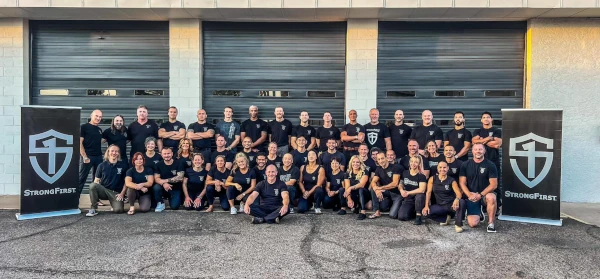

While we (ToS) come from diverse backgrounds, we share the love of teaching and coaching people to greater levels of physical strength for a variety of purposes including longevity and healthy living, competitive advantage for activities and sports, and safety on the job (e.g. LEO, military).
We all also strive to “walk the talk” by continually improving our own skills and capabilities. For example, more than a few of these gentlemen can military press a 48-kg (106-lb) kettlebell for reps, while more than a few of the ladies can do double-digit, strict pull-ups with minimal fanfare.
Of course, plenty of us have developed or are working toward improving other skills and capabilities—we’re strong first, not strong only(!)—including flexibility, aerobic endurance, and strength reserve (e.g. work capacity).
One individual, Noah, has been training to achieve Double Sinister. (Cue spooky Halloween music.)
OK, so Double Sinister isn’t exactly scary; it’s just a lot of work in not much time. Here’s what it is and what we might take away from Noah’s efforts and apply to our own training.
Simple, Sinister, and Double Sinister
The whole idea stems from the training program and occasional test in the book, Simple & Sinister.
The highly abbreviated program is:
- Do 10 sets of 10 high-power, one-arm swings. (That’s 50 swings per arm.)
- When the swings are complete, do 10 sets of 1 get-up. (That’s 5 get-ups per arm.)
During training, each set of swings and get-ups is performed when you’re able to pass the “talk test” (i.e. being able to say a few short sentences on a single breath).
Doing this with any weight would be beneficial. But as with most things, having a target to aim for provides a greater sense of purpose, motivation, accomplishment, and, in this case, physical capabilities.
As you may have guessed, Simple and Sinister (in both untimed and timed variations) are the targets.
The requirements are:
- Women
- Simple: 24-kg swings, 16-kg get-ups
- Sinister: 32-kg swings, 24-kg get-ups
- Men
- Simple: 32-kg swings & get-ups
- Sinister: 48-kg swings & get-ups
In the “timeless” variations, all sets of swings and get-ups are performed with “talk test” rest periods between. In the timed variations, the swings must be completed in five minutes and the get-ups in ten minutes (after the swings and one minute of rest).
While the book doesn’t offer a Double Sinister variation, Noah thought it would be a reasonable challenge for his current capabilities and to help focus his training.
If you’re thinking it sounds like completing two Sinisters back-to-back, you’re close, but you’d be taking the easy way out. (Ha!)
It’s actually 200 swings (20 sets of 10 reps) in ten minutes followed by a one-minute rest and 20 get-ups (20 sets of 1 rep) in twenty minutes.
With a 106-lb (48-kg) kettlebell.
Sounds fun. 🤣
Why?!?
Right about now, you might be asking yourself that question with two different contexts in mind:
- “Why would he want to do that?”
- “Why would any of that be useful info for me?”
The answer (from Noah) to the first question has three main parts:
First, he wanted something that would challenge his current capabilities (he had already completed Sinister) while enabling him to stay within his body’s ability to recover (which he noticed had declined slightly, being in his early 40s).
Second, he wanted something with a simple (but not easy) training program that he could do between coaching sessions (so he’d know that he had time to complete his training) and a well-defined way to progress (so he didn’t need to spend much brainpower on it).
And, third, he needed the plan to leave him with enough energy after training to be able to work on his house (which he’s fixing & remodeling).
Double Sinister seemed to fit the bill.
The answer (from me) to the second question also has three parts:
(There are certainly more takeaways, but these seem the most important in my experience.)
First, we don’t need to do a ton of exercises to build strength, improve endurance, or manage body composition. Two will do, at least if we pick the right ones and put in appropriate effort. Those two don’t need to be swings and get-ups, but they work almost everything and are a reasonable place to start.
Second, training doesn’t exist in a vacuum. We need to honestly consider our stress, energy level, ability to recover, and availability, among other factors. When we have a reasonable understanding of those things, we can better choose a program that will produce the results we’re after while not adding unnecessary stress to our lives.
Finally, pursuing a meaningful goal makes even seemingly boring training enjoyable, or at least tolerable. During our conversation, Noah didn’t elaborate on whether he found the program boring or fun. But he was excited about achieving his goal (which he expects to do in early December, assuming his current rate of progression continues). And considering he’s been following this program for about a year, it’s fairly easy to see what’s most important.
Putting it into practice
While you may never want to move over 23,000 pounds in thirty minutes (the end result of Double Sinister), spending a few months practicing swings and get-ups with any weight would produce noticeable improvements in your shoulder and low-back health, general strength and endurance, and body composition (assuming you’re also paying attention to your nutrition).
If you currently train at TNT, you’re lucky enough to be starting such a program after the Tactical Strength Challenge later in the month. (Don’t worry, there will be a couple other movements besides swings and get-ups… even if those two will be the main course!)
And if you don’t currently train at TNT, well, there’s no need for you to miss out! There’s always a StrongFirst Kettlebell 101: Simple & Sinister course being hosted at the gym sometime within the next few months.
At the course, we spend four hours covering the finer details of the kettlebell swing, get-up, and goblet squat, as well as some programming ideas for training at home.
If you’re a complete kettlebell beginner, you’ll leave with solid technique and a plan for starting training the next day. And if you already have some experience, you’ll refine your technique and be reminded of a few important subtleties that you may have forgotten (or been ignoring).