
I’m often asked about the best way to stretch specific muscles.
In person, the process of determining which muscle group needs some care and choosing an appropriate stretch is simple:
- The questioner points to the area that’s tight.
- I demo a specific stretch.
- The questioner tries it and lets me know if the tight muscle is the one that feels the stretch.
- We repeat the process if not.
But that obviously doesn’t work in a tip like this.
Since the body contains hundreds of skeletal muscles—some of which are pictured below—describing highly advanced techniques or demonstrating every single common stretch is unfeasible. (Although I have started the process in past tips by covering the Brettzel, a hip/quad stretch, and a spine/shoulder stretch.)
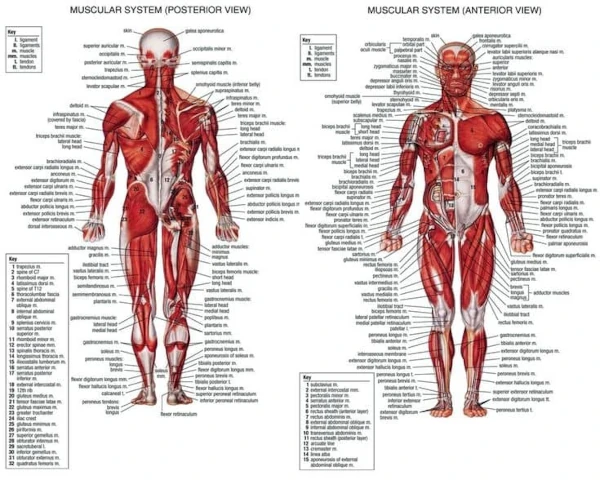
Still, stretching doesn’t need to be complicated. So while you’re waiting for me to send future tips covering another 97 different stretches, use the following 3+2+1 approach to start improving your flexibility today!
Three steps to stretching
Even if you’ve never been shown a single stretch, figuring out how to effectively stretch a specific area of the body doesn’t require an advanced physiology degree. Instead, follow these three simple steps:
- Determine the muscle that needs to be stretched by observing where you feel tight.
- Determine how that muscle contracts by placing a finger on the tight muscle and moving the surrounding joints. When the muscle contracts, or tightens further, you’ve determined what movement activates the muscle.
- To stretch it, move and apply pressure in the opposite direction.
As an example, our quadriceps—quads, for short—are the muscles on the front of our thighs. The quads contract when we extend/straighten our knees and flex/bend our hips. So to stretch them, we need to do the opposite: flex our knees while extending our hips. (See the hip/quad stretch linked above for more details.)
Two strategies for a deeper stretch
When most people hear the term “stretching”, what they’re visualizing is static stretching. That is, getting into a stretch and holding it for 10 to 30 seconds or more.
While it is an effective strategy, it’s also a slow one because it requires a stretched muscle to fatigue before being able to stretch farther.
We can achieve a deeper stretch faster by using some of our bodies’ natural reflexes. (Don’t get caught up in the following terminology. The names are fancy, but the concepts are simple.)
Start by stretching a specific muscle.
Proprioceptive Neuromuscular Facilitation (PNF) stretching is performed by (1) contracting the muscle being stretched—by pushing it against the floor or a wall, for example—and then (2) stopping the contraction. It works by making use of muscles’ normal process of relaxing after tensing. Stretch (and hold) → Tense → Relax → Stretch farther.
Reciprocal Inhibition (RI) stretching is performed by (1) contracting the muscle opposite of the one being stretched—for example, flexing your quads (i.e. straightening your knee) while you’re stretching your hamstrings—and then (2) stopping the contraction. As the name implies, it works by making use of muscles’ normal process of relaxing when the muscle on the opposite side of a common joint is active. (This what makes movement possible… You wouldn’t be able to bend or straighten your arm if your biceps—in the front—and triceps—in the back—were active at the same time.)
One task to always complete after stretching
You’ve probably noticed that stretched muscles tend to revert back to their normal, tight states shortly after stretching—we’re talking minutes to possibly a few hours.
This occurs because stretching basically tricks the body’s reflexes into allowing muscles to stretch beyond their typical status quo, but the status quo is resumed once the effects of the tricks dissipate (for injury prevention among other reasons).
To gradually change a muscle’s normal resting & movement lengths over the long-term, we need to stretch the muscle and then strengthen it over its newly extended range of motion.
Perhaps surprisingly, the weight used during the strengthening exercise doesn’t need to be heavy. A set or two of 8-10 reps of body weight squats or lunges (after most lower body stretches) or push-ups, presses, or light rows (after most upper body stretches) will do the job.
Of course, stretching for a few minutes after performing a more general warm-up and then finishing with your normal weight training routine works too.
Putting it into practice
Since muscles tend to stiffen with age—and none of us are getting any younger—stretching should be a regular part of everyone’s fitness routine. But that doesn’t mean it needs to be a chore that takes hours per week. Just a few minutes is plenty if performed regularly.
So try this 3+2+1 method during a training session this week or the next time you notice a tight muscle. You may never out-stretch a yogi, but you’ll gradually improve your flexibility and maintain it for years to come.