
If you spend any time during the day looking down—scrolling through your phone, sitting at a desk, working on a patient, bending over to do yard work or other labor—try the following weighted stretch at the end of the day or prior to weight training.
It will target your triceps (back of your upper arm) and “lats” (biggest muscles in your back) as well as mobilize your thoracic spine (mid-back where we all get a little “hunched” after a long day), all of which should improve your overhead shoulder mobility and help you to stand a little taller. And that, of course, feels fantastic!
Setting up
Unlike most stretches which require only your body, we’ll need a couple extra pieces of common equipment for this one: a bench or similar-height box and some type of weight. A kettlebell or weight plate is probably the easiest and most comfortable weight option, but a dumbbell will work if that’s what’s available.
Start out by kneeling slightly less than an arm’s length away from the bench or box. Pick up the weight and maneuver it to rest on or between your shoulder blades. Your palms should be facing your back, as seen below.
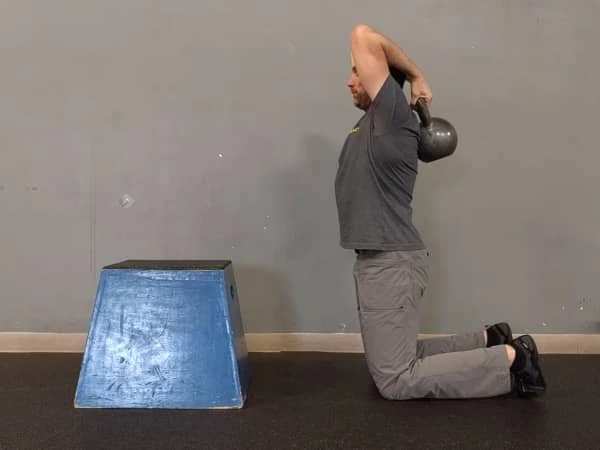
If you’re using a kettlebell, the handle will likely be wide enough that you’ll be able to grasp it with your hands side-by-side. The same goes for using a weight plate. But definitely be extra careful in that case since you’ll be gripping the “lip” of the weight, and that’s not nearly as strong as being able to completely grasp a handle.
If you’re using a dumbbell, you’ll probably want to grab the handle with one hand and then grasp the knuckles of that hand with your free hand. In this case, one arm will likely experience a more intense stretch than the other, so make sure to repeat the stretch after switching up your grip.
The Stretch Proper, plus a common mistake
To perform the stretch, slowly hinge from your hips until you’re able to place your elbows on the bench/box, as seen below. After you reach the bench/box with your elbows, you may find that you’ll need to slightly walk your knees backward in order to feel comfortable.
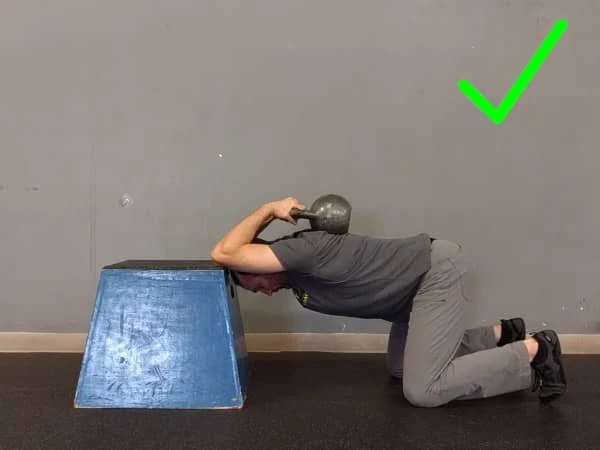
Make sure to maintain two specific conditions before you relax into the stretch and while you’re in the stretch:
- Your elbows should be as close together as possible. If your arms are basically rubbing your ears, that’s great! If you’re not able to get your elbows that close together, that’s OK. You’ll get there with practice. 😉 In the meantime, just make sure to bring them as close together as possible instead of allowing them to “flare” out to the side.
- Your abs should be braced, keeping your lumbar (lower) spine in a neutral position. Don’t allow your lumbar to hyperextend (see image below).
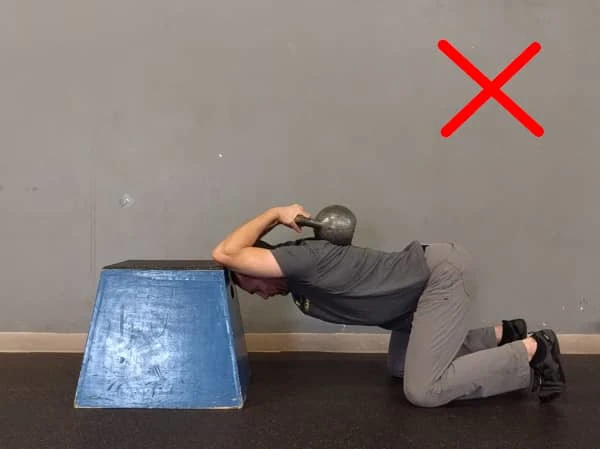
Once you’re set, exhale while trying to push your chest toward the floor (the weight will help). Remember to keep your abs braced!
On your next inhalation, slowly “pulse” out of the stretch along with your breath. Repeat for a total of 8-12 breath cycles.
After the dozen-or-so breath cycles (or simply after you’ve had enough), walk your knees closer to the box and extend your hips or sit back onto your feet to come out of the stretch. Maneuver the weight back over your shoulders and set it down.
Optionally, you can ask a partner to hand you the weight after you get into the stretch and take the weight when you’re ready to come out of the stretch. In any case, start light! This is weighted stretching, not weight training!
Putting it into practice
As I mentioned at the beginning of the tip, this is a great stretch to perform after a long day of work. It would also be an excellent addition to your warm-up routine prior to strength training. In that case, you’ll find it particularly helpful if you plan to perform any overhead lifts (military presses, jerks, pullups, snatches) or barbell back squats during the session.
Give it a try this week, and let me know how much you love (or hate) it!