
Last week after a group training session at the gym, I was playing around with doing handstands on parallettes. (It’s something I’ve been practicing on-and-off for years.)
A few days later, one of the ladies who had been in the session told me she was fascinated with how I seemed to dial in my focus immediately before each attempt.
She proceeded to say that her mind often seems to be in ten different places, especially when doing kettlebell snatches, and asked two questions:
- What do I focus on, in general, before lifting something heavy or doing a challenging movement?
- What do I focus on (and what should she focus on) while snatching?
I answered that I always do three things before starting a set of anything: take a breath (through my nose), do a quick scan of how my body currently feels, and quickly imagine how it will feel or, at least, how it’s supposed to feel during the upcoming movement.
This mentally prepares me for the effort I know I’m about to exert and primes my body to move as well as it possibly can, which lowers the potential for injury and contributes to improving technical ability. How that works is a story for another time. In any case, it’s an effective mental focus strategy that takes only a couple seconds to complete once you’ve practiced a bit.
But when it comes to directing focus while snatching or performing other “quick lifts” (e.g. swings, jerks, jumps, sprints), an entirely different strategy is needed.
The details of that strategy will vary based on experience level, although the reason for needing it is the same. Because the movement is fast, there’s too little time to linger on any particular thought for more than a fraction of a fraction a second without quickly falling behind where your body is in the sequence of the movement.
So then, where should focus be directed while lifting?
For beginners who are learning an exercise or working to improve a certain part of their technique, I typically recommend spending a few seconds before a set thinking through one small part of the movement. Then perform the set without too much thought other than focusing on that specific part. Finally, mentally review whether the pre-set intention aligned with the intra-set reality after the set is complete.
This narrowing of focus during the movement teaches and improves a meta-skill that will be used as experience grows: ticking the box.
Ticking the box is effectively the third step performed by the beginner, except it’s done at a more advanced level as an extremely quick “check-in” or, better yet, an even quicker “recognition” that the body felt (or didn’t) the way it was supposed to at given points during the movement.
Check out the image and descriptions below for an example of where I tick the box while snatching.
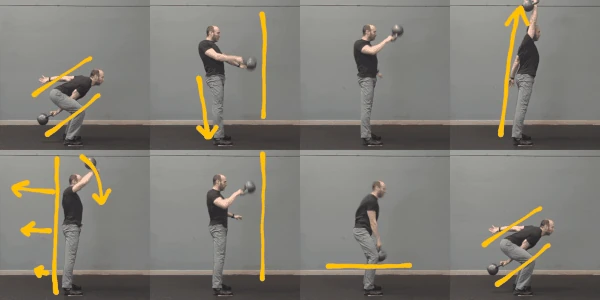
Three points to note about the following “descriptions”: First, the points are intentionally brief in order to cover the boxes that I mentally check as opposed to teaching specifically what to do or why to do it. Second, I can’t emphasize enough that I don’t actually even mentally “verbalize” the words but rather “tick the box” as soon as I feel what I’m supposed to feel. Finally, the numbers correspond to the “phases” in the image above, from left to right and top to bottom.
- Aligned + “hu” (That’s “hut” without the “t”.)
- Jump + pull
- Silence
- Punch + exhale
- Lean + drop
- Close
- Play chicken
- Sniff + repeat
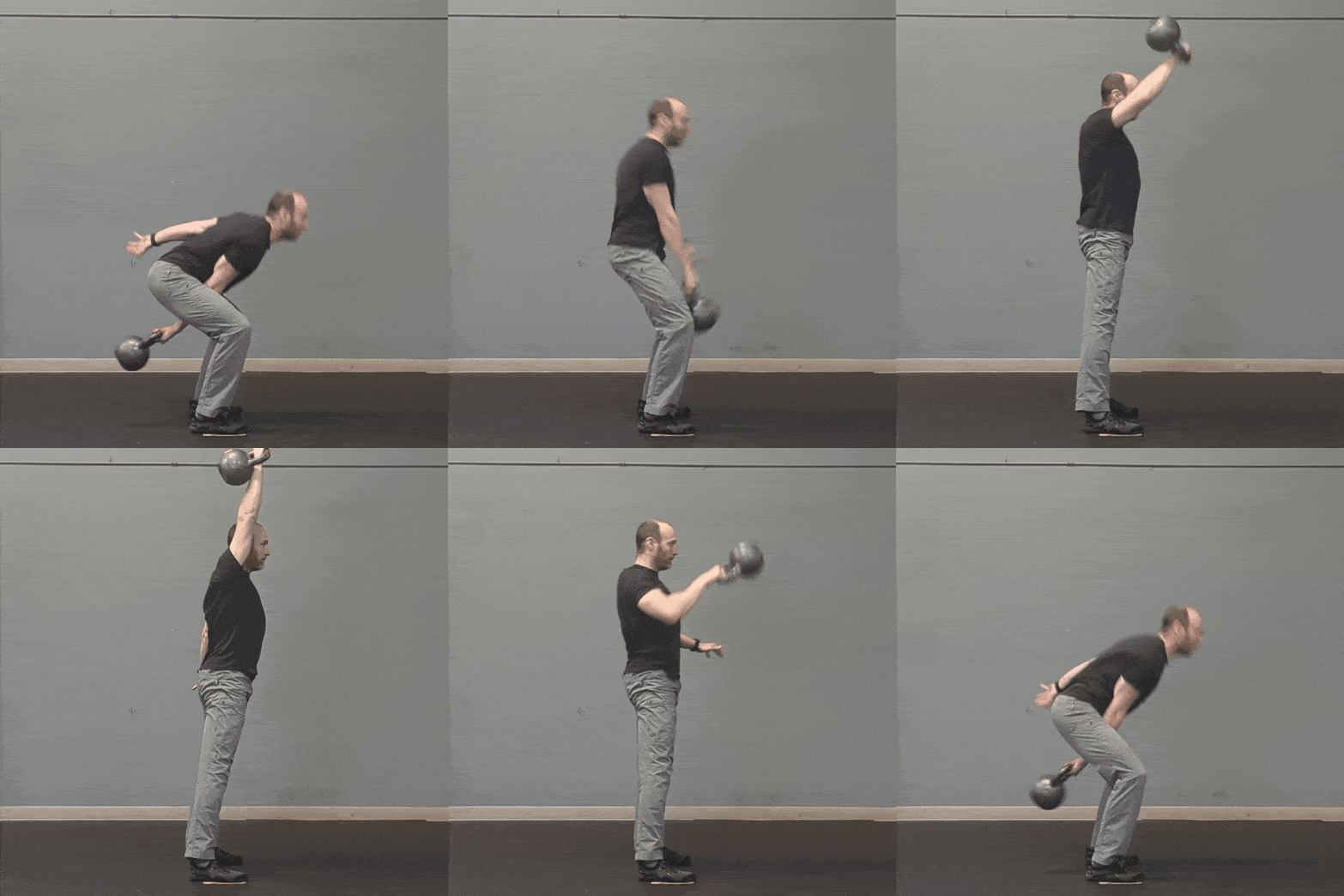
And if you want to see what the movement actually looks like outside of still-frame, here’s a single frame-per-second GIF.
Putting it into practice
If kettlebell snatching (or some other quick lift) is currently a part of your training regimen, consider intentionally practicing either the beginner intend-do-review strategy or the more advanced ticking the box strategy during your next few training sessions. Then take note of anything that seems different compared to prior sessions, especially where technique is concerned.
Next week I’ll discuss a little more about why improving your technical ability is important (beyond the obvious reason of reducing the risk of injury) as well as why “good enough” is sometimes good enough.