
Last week I offered a high-level approach to designing simple training plans, either for your own use at home or to help you better understand how I design programs at the gym.
In the first step, which was deciding on an objective and choosing a few high-level movements, I cautioned against choosing too many characteristics (i.e. objectives) and exercises so as to better focus and utilize your body’s limited adaptive capabilities.
In conversation, this advice typically prompts two questions:
- What are the possible characteristics that I can choose?
- What if I want to develop multiple characteristics?
In order to begin to answer those questions, it’s helpful to discuss Dan John’s “quadrants idea” to which I was first exposed at the Easy Strength workshop and, subsequently, in the book by the same name back in 2012.
Qualities and capabilities
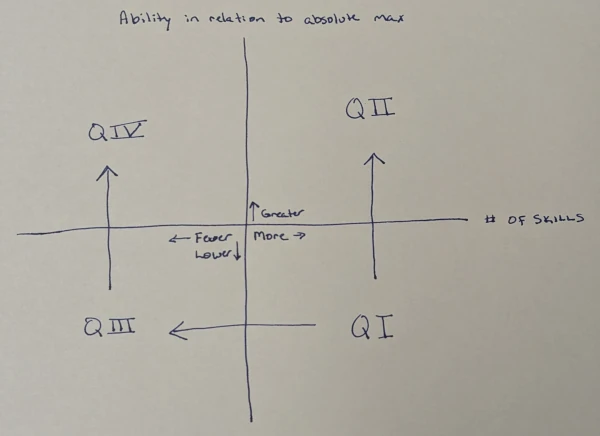
In this idea, the quadrants are created and differentiated by the intersection of two simple concepts: the number of qualities required to do a thing—sports, using Dan’s example, although the concept applies to any activity or goal—and your current capabilities/skills in each of those qualities in relation to the absolute maximum of each quality.
Quadrant I occurs where a large number of qualities meets a low level of skill. Grade school physical education is a perfect example. In gym class, you learned a lot of different skills for a variety of sports and activities, but you only practiced them for a brief time and didn’t develop beyond an amateur level.
Quadrant II maintains a large number of qualities but requires a high level of skill. Think of professional team sports here.
Quadrant III involves a small number of qualities performed at a low to moderate level of skill. This is where most of us likely live as adults. We (hopefully) regularly participate in a few activities. And while we might be reasonably good at them, we’ll probably never find ourselves participating in the Olympics.
Quadrant IV is where a small number of qualities meets a high level of skill. This is the realm of individuals like world class track athletes and powerlifters.
The tale of two progressions
In order to answer our initial two questions, we need to recognize two more concepts related to the quadrants.
The more obvious of the two is that skill develops with practice. So if you want to someday become an Olympic athlete or play on a professional sports team, you’ll have to progress from a low level of skill to a higher level of skill. In other words, the direction of progression is QI (more qualities + lower skill) → QII (more qualities + higher skill) and/or QIII (fewer qualities + lower skill) → QIV (fewer qualities + higher skill).
The less obvious of the two is that understanding which skills to practice and how to go about prioritizing the process is easier if you’ve been exposed to a wider range of activities and, subsequently, qualities. For example, if you’ve never been exposed to strength training and its benefits, you’re less likely to even begin to imagine how improving your strength could affect your endurance and subsequently improve your marathon time. In other words, another direction of progression is QI (more qualities + lower skill) → QIII (fewer qualities + lower/moderate skill).
(It might initially seem confusing to say that adding some strength training to your endurance/running training is QIII instead of QI. But the thing to remember is that QI is actually strength + endurance + flexibility + running + jumping + sports skills + a bunch of other stuff, while QIII in your specific case is endurance + running + a little strength to support the other two qualities.)
Ultimately, the point I want to make is this: If you have minimal experience participating in a variety of activities (i.e. QI), it’s much easier to either become myopic when deciding what characteristics to train or believe that all possible characteristics can be trained simultaneously to a high degree.
Alternatively, the more experience you’ve had in QI, the easier it will be to figure out for yourself which characteristics are important for your preferred activity or goals and to prioritize the development of those characteristics.
Putting it into practice
In an optimal scenario, you’d have loved gym class, remained active throughout your life to this point, and would be right about where you want to be with your health, fitness, and participation in some activities that you love.
If that’s the case, awesome! And none of what’s above is probably new to you.
Of course, it’s totally fine if that’s not the case. Optimal scenarios aren’t always the most common. The best advice I can offer here is simply to try new things!
Take a yoga, powerlifting, kettlebell, or spin class. Or get a few private golf or pickleball lessons. Go for a walk, hike, jog, bike ride, or swim. Check out a rock climbing or martial arts gym.
Whatever you do, remember that you’ll probably be terrible at it. But that’s OK. You’re intentionally spending time in Quadrant I. Eventually you’ll find your jam and progress to Quadrant III. In my experience, that’s where the real fun begins.