
“I just don’t understand why I don’t have the willpower to not eat chips/cookies/other-bad-for-me-food when I walk in the door after work.”
Have you ever thought or said something like that?
If so, you’re definitely not alone! (If I had a dime for every time someone admitted as much to me, I’d have a lot of dimes.)
Lapses of willpower in cases like this occur for numerous reasons: not having eaten enough food (and/or protein) earlier in the day, habit, high stress, or mental fatigue. But, ultimately, the biggest reason for the momentary lapse is having depended on willpower to steer you correctly in the first place.
Offense vs. Defense
Willpower is like a muscle in that it grows stronger the more we use it. But like another muscular attribute, it also becomes depleted with overuse, too little sleep (or food), or too much mental stress and fatigue.
So we’re only setting ourselves up for failure when we approach our days expecting to be able to use willpower like an endless wellspring.
Of course, there is a strategy that enables us to make better use of our limited willpower reserves.
Roy Baumeister—a highly-cited social psychologist and willpower expert—says that using willpower wisely means playing offense with it instead of defense. In other words, using willpower efficiently means building habits, routines, and rituals that help us to simply avoid those temptations that drain our willpower in the moment of resistance.
In the example above, this might mean leaving the cookies, chips, or Almond Snickers (my personal Kryptonite) at the grocery store so that we’re not tempted by them when we walk in the door after a long, stressful day at work.
An Even More Positive Approach
While using willpower to avoid buying cookies at the grocery store may be a more efficient choice than using it to avoid eating them at home, it’s still an example of prevention. And that has a somewhat negative feel to it.
Life is, of course, not all rainbows and unicorns, so we definitely need to learn to use our willpower this way. But science has also shown that inspiration to take action is generally a better strategy than prevention from taking an opposite action.
On that note, I’ve observed over the years that people who have their nutritional habits fairly dialed in (myself included) seem to follow what I call a “meal plug-and-play” approach.
If that sounds like “meal planning” to you, it is but with a few key differences.
Meal planning is a fairly regimented process that usually includes detailed planning of what will be eaten at which meal and perhaps preparing a few days’ to a week’s worth of meals in advance. That can certainly be a time-saving process and helpful for staying on track. But it can also eventually feel like a bore (because planning often removes spontaneity) or a chore (when you’re staring down a week’s worth of meal prep on a Sunday afternoon).
Meal plug-and-play is similar in that it involves making sure all the necessary ingredients to make specific meals are on-hand and perhaps prepped (e.g. thawed, washed, chopped). But it differs in that a list of options for each mealtime is planned, which offers a feeling of freedom-of-choice at each meal.
As an example, below is a high-level overview of my current options:
- Protein shake, small handful of mixed nuts, two bananas, two pieces of whole grain toast with almond butter (breakfast; < 2-min prep)
- Five eggs topped with enchilada sauce & guacamole, small handful of mixed nuts, two apples (breakfast; < 10-min prep)
- Pancakes (Kodiak high-protein mix, chocolate protein powder, two eggs, cinnamon, water) topped with fruit (breakfast; > 10-min prep)
- Greek yogurt with fruit (lunch; < 2-min prep)
- Leftovers from last night’s dinner (lunch; < 2-min prep)
- Chipotle burrito (lunch; < 10-min prep/travel)
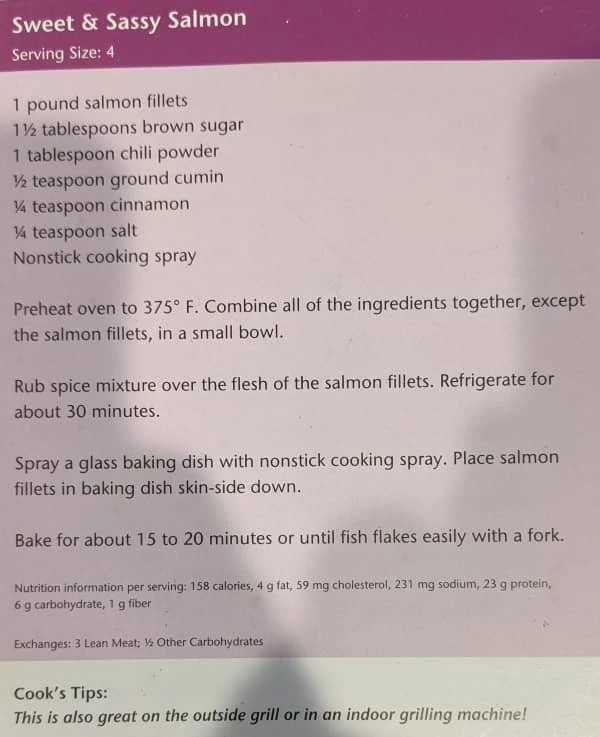
- Sweet & sassy salmon (see image below), sweet potato, raw veggies w/hummus (dinner; < 20-min prep… I don’t do the “refrigerate for 30 minutes” part)
- Lots of other dinner options & a few other breakfast & lunch options which cycle as the seasons change.
Bonus Points
There are three other major benefits to the meal plug-and-play idea:
First, the more you make a specific meal or stick with a list of meals, the faster you’ll get at grocery shopping, deciding which meal to have given a set of circumstances (e.g. available time, hunger, fatigue), and actually preparing the meal. That all adds up to time that can be spent doing other things, like activities that renew & refresh your willpower!
Second (and arguably more important), each meal can easily be viewed as its own stand-alone unit. This is an invaluable trait if you’re on a journey to improve your nutritional habits. Instead of feeling like you need to “fix your entire diet”—which is a stressor that will drain your willpower roughly this fast—you can use your willpower to plan minor improvements to one specific meal. After the minor change becomes part of that meal’s routine, which is often within a few days or weeks (depending on the number of options you’re cycling through), you can focus on making another minor improvement to that or another meal. Within a relatively short period of time, a lot of minor improvements to a few meal options add up to huge overall improvements.
Finally, variety and spontaneity become easier with the plug-and-play approach. If you’re getting tired of a specific meal, swap it out with a new option that has a similar macronutrient (e.g. protein, carbs, fat) profile, and carry on.
Putting it into practice
If you do something along the lines of the meal plug-and-play already, consider either making one small improvement to a single meal or swapping one meal for a new option this week.
If the idea is new to you, give the process a try. You can start by simply documenting your meals this week. Then next week follow the improvement suggestion above, and you’ll be well on your way to a better diet with less demand on your willpower.