
My brother and I spent last weekend in Austin, TX with a friend & business partner getting a behind-the-scenes look at his 3-day, 1200-competitor CrossFit event.

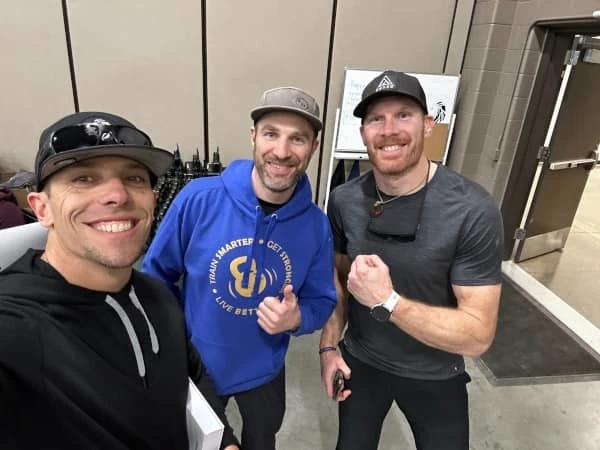
It was a fun and educational experience that also included a couple great conversations about our joint business venture (the main point of the trip) and some fitness industry trends.
One of the topics that resurfaced numerous times throughout our conversations was the idea that more people have begun to express interest in taking on challenges outside the gym.
Of course, every exerciser appreciates setting new PRs (personal records) in the gym or seeing changes in the numbers on the scale or in clothing size.
But at some point in most fitness journeys, we realize that the mobility, strength, and conditioning characteristics that we’ve developed need to be used for stuff other than sitting behind a desk all day or having an easier time getting off the floor or up a flight of stairs.
We feel the pull to hike, kayak, play pickleball, participate in triathlons or adventure races, climb mountains, learn a martial art, or take on any other number of physical challenges or competitions (like the upcoming Tactical Strength Challenge).
And that motivates us to refine and improve our eating, sleeping, and training habits in order to more easily overcome and enjoy the outside-the-gym challenges we undertake.
All of which leads me to the point of this week’s tip.
The five why’s
The unsurprising takeaway from the overview above should be that having a strong purpose is motivating.
That is, disciplining ourselves to do the things we might not want to do but which will help us improve becomes easier when we have a powerful reason.
So regardless of where we are on our individual fitness journeys, discovering (or rediscovering) our purpose for training should be a top priority. The problem is that most people, especially those who are just beginning to exercise, often settle on a too-weak, surface-level purpose.
In order to get to a stronger, hit-you-right-in-the-feels type of purpose, we need to dig a little deeper. And a simple way to dig deeper is to ask yourself “why” numerous times in succession.
The actual number of “why’s” is unimportant. Five was simply the number used when I was first exposed to the idea. What is important is that we don’t stop asking until we get to a fairly emotional answer.
For example:
“I want to lose weight.” (Weak purpose that’s unlikely to be motivating on cold mornings at 5 AM when the bed is warm and you “don’t feel like going to the gym”.)
Why? “Because I think I’ll be healthier.”
Why is that important? “Because I’m more likely to live longer.”
OK, cool. But why is that important? “Because I want to play a big role in my kids and grandkids lives unlike my grandparent who passed at 55 from heart disease.”
Yeah, now we’re getting somewhere. How likely are you to skip a training day with that reason on your mind? My guess is “not very”.
Or:
“I want to build a leaner and more muscular physique.” (Weak purpose that probably won’t inspire you to prep meals every Sunday instead of watching whatever game happens to be on.)
Alright, but what will that do for you (i.e. why)? “I think the struggle and achievement will improve my overall confidence.”
Why is that important? “Because I’m in sales, and I think that personal confidence will carry over into my interactions with prospects and result in more income.”
Sounds like a plus. But why is that important? “Because my family didn’t have much when I was growing up, and I want to be able to provide my kids with more opportunities.”
Bingo! Take one look at your kids on Sunday morning, and replacing the remote with a cookbook will be child’s play.
And finally:
“I want to get stronger and better conditioned.” (Weak purpose that will be the last thing on your mind when the training plan says to do one more set but you had a rough day at work.)
Why? “Because some friends have a National Park hiking trip planned. I want to go along but would currently slow them down too much.”
Why is going along important? “Because my life is pretty routine, and I want to see some amazing sights in-person and experience some adventure!”
Excellent! Tape a picture from the park’s website to the cover of your training journal, and let’s get to work!
Putting it into practice
Especially if you’ve been feeling less than extremely excited about starting or sticking with an exercise, nutrition, or sleep program, take some time this week to ask yourself why doing so matters to you.
Then ask yourself again. And again. And again.
Don’t stop until you settle on an answer that gives you either (excited) butterflies or (queasy or uncomfortable) knots in your stomach.
The digging might be challenging. And the emotions might be uncomfortable. But you’ll end up with a tool that you can use when fear, fatigue, uncertainty, apathy, or a simple lack of motivation threatens to push you off the path to your goals.