
I’ve mentioned in plenty of previous tips (and you’re probably well aware in the first place) that consistency is a primary driver of results when it comes to fitness, nutrition, and, well, just about everything else we do in life.
But it seems to me that many people, consciously or otherwise, tend to equate consistency with a general sense of overzealousness. That is, not only does being consistent mean “showing up daily” but also “focusing completely” and “having to dedicate a lot of time” and “always being motivated”.
In other words, using exercise as an example, this (Mon-Sun routine) is what many people think exemplifies consistency and is required to produce results:
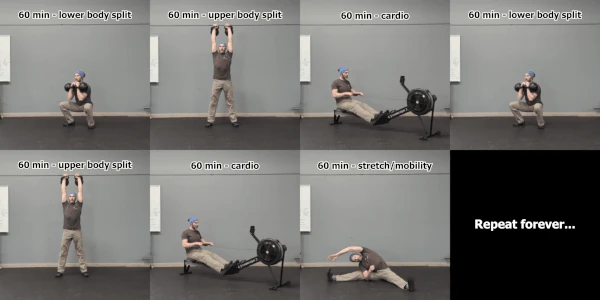
Now I don’t mean to imply that there’s anything wrong with following a plan like what’s above. It certainly would produce results—assuming that you’re operating at the appropriate intensity. And plenty of people have done more. So if you have the time and energy to do so, find the process enjoyable, or have a goal that you needed to achieve yesterday, then rock on!
That said, especially in the early stages of developing new habits, when life becomes a little hectic, and as a general example of what consistency actually looks like, this is a closer representation of reality:
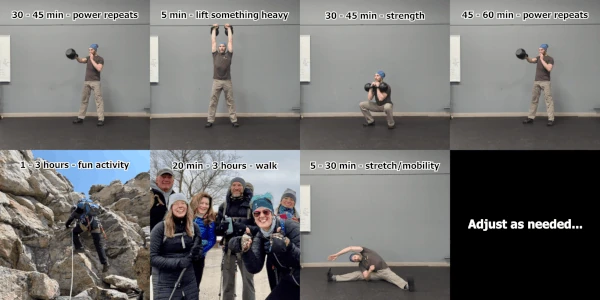
To summarize and be direct, being consistent does mean showing up daily.
But that’s it.
Sure, there will be times when you’re highly focused. But there will also be times when you simply go through the motions.
There will be times when you have plenty of extra free time at your disposal. But there will also be times when five minutes (or 30 seconds… or one rep) is all you have the physical or mental capacity to dedicate.
And there will be times when you’re extremely motivated. But there will also be times when you don’t “feel like it”.
Being consistent means showing up and doing something during any and all of those times.
“But I have to do more than just show up…”
In order to achieve some goals, the above statement is true. You will need to put in a certain minimum amount of work as your objectives become more advanced.
However, you’re unlikely to do so if you haven’t already developed the habit of consistently showing up, in one way or another, whether you feel like it or not.
Which leads me to a practical tool for developing consistency: floors and ceilings.
In How to Be an Imperfectionist, Stephen Guise describes the idea of having floors (acceptable minimum targets) and ceilings (crushing it to near-perfection targets) for our goals and processes.
Just like any (usable) building ever created, there must be space between those floors and ceilings. If there is and we operate between them based on our capacity on any given day, we make progress toward our goals and build confidence in ourselves for doing what we decided to do—taking consistent action, whether big or small.
Alternatively, floors and ceilings that are equivalent leave us with no wiggle room for action. Which can easily push us into the trap of not doing anything because we’re unable, for whatever reason, to perform at the perceived requisite level.
And not doing anything is the exact opposite of what we’re after.
Putting it into practice
Consider a goal that you currently have and your consistency of daily action in relation to that goal.
Are there days in which you don’t take any action toward its fulfillment? And are there other days when you’ve planned to take action but don’t, for whatever reason?
If the answer to either question is “yes”, consider WOOPing the goal and in the process develop some floors that you could implement into your daily life.
I assume you already have some ceilings. But write them out on a sheet of paper anyway so that you can see them. Doing so will make them more real and help you more easily (and consciously) decide if they need to be adjusted.
Your consistency and results will benefit.
(By the way if you’re curious, my “five minutes of lifting something heavy” today was completed while creating the images for this tip.)