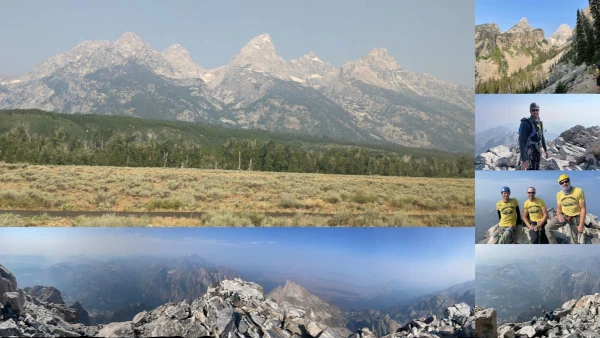
For a number of years my brother has been making social media posts that he calls Observations of an Inspired Climber. These posts contain lessons he’s learned while rock climbing and observations of how those lessons apply to life, in general.
Since you’ll be receiving this tip right around the time that he and I and a couple friends will be coming down from Grand Teton—having summitted the day before and planning for two more summits within the following five days—I thought it an appropriate time to pay tribute to his idea by writing my own Observation of an Inspired Climber.
My first summit
Grand Teton sits in a range of peaks just outside of Jackson, WY. With a summit of 13,775 feet above sea level, it towers 7,500 feet above the grassland plains, forests, lakes, and beautifully winding rivers that surround it. The entire range is an amazing sight to behold. And reaching the summit makes for a challenging and epic hiking and climbing experience, particularly if you make a rather suboptimal choice of backpacks. (Don’t ask. 🤦♂️)
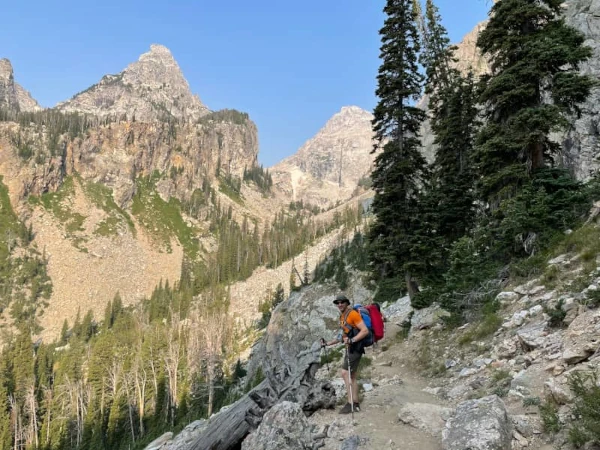
The super-abbreviated timeline was:
Day 1: Hike 10.5 miles—because we parked in the wrong lot a mile farther down the road—and gain 5,000 feet to reach Lower Saddle between Grand and Middle Teton. (At least half of that elevation comes in the last few miles. More on this in a minute.) Pitch the tent and sleep.
Day 2: Hike a few hundred yards before taking the technical climbing Exum Ridge route to the summit. Hike, rappel, and hike some more to get back to camp. (Gain and lose 2,500 feet of elevation.) Filter water, skip supper, and fall asleep before the head hit the inflatable pillow.
Day 3: Hike 10.5 miles out (with that dumb backpack setup again). On the bright side, we wouldn’t have had the opportunity to see the bear meandering across the path within a half-mile of the Jenny Lake visitor area (😬) if we hadn’t parked where we did.
The lesson
There were plenty of lessons learned on this trip, but the one I want to discuss—which happens to be the advice I’ll be offering to the friends with whom we’ll be summitting tomorrow—came on Day 1.
Beyond the trees in the pic above, you’ll find Garnet Canyon nestled between the Nez Perce, Middle Teton, and Grand Teton peaks. At the end of the canyon is a waterfall, the source of which is runoff from the daily Middle Teton Glacier melt. The top is a great place to have lunch (after a bunch of steep switchbacks, of course).
After leaving the waterfall, there’s a long hike (and a lot more elevation gain) up a boulder and scree field to the Lower Saddle. This “field” goes on for over a mile up a steep hill composed of multiple sections. Some sections contain vehicle-sized boulders that you need to step across. Others contain loose dirt and gravel-to-basketball-sized rocks that slide ever-so-slightly downhill with every step you take.
If you haven’t guessed, it’s a tiring section. And that’s where the strategy and lesson come in.
There are two reasons to focus on the trail directly in front of you. First, you need to watch your footing so you don’t trip or slip on the loose dirt and rock. But more importantly, it’s mentally easier. Focusing your gaze on the Lower Saddle is depressing because it seems to take a long time to actually get any closer. On the other hand, focusing on the “next big rock” in front of you offers small and successive, confidence-boosting wins as soon as you reach them and pick your next target.
The only problem is that there are multiple winding paths that were created by the feet of numerous visitors and locals, some of whom jog (unencumbered) to and from the Lower Saddle on a regular basis for exercise. If you never look up toward the Saddle to readjust your bearings, you’re likely to end up taking a longer, winding, and more exhausting path.
The best strategy—the one that’s a solid combination of the safest, shortest, and least depressing (or most inspiring, if you prefer)—is spending most of your time watching the path in front of you while taking regular but very brief glances at the Saddle to make sure you’re following the most direct route.
Putting it into practice
As it turns out, that’s also the best strategy for achieving your fitness goals. Whether your goals include losing weight, getting stronger, building muscle, reducing aches and pains, or any other target, you can’t just wake up tomorrow morning having achieved it. And especially if you feel you’re a long way from achieving your goal, focusing on all the work you’ll need to do in order to achieve it (à la reaching the Lower Saddle) can be demotivating.
Instead, focusing on the tiny and unglamorous daily actions—e.g. getting in some extra steps, swapping one bag of chips for some vegetables, going to bed on time, drinking a glass of water upon waking, choosing a heavier weight for a single exercise in the day’s training session (à la watching the trail in front of you)—will steadily move you in the direction of your goal until, finally, you wake up one morning having achieved it.
Just remember to also occasionally “look toward” your destination, not only to make sure you’re on a reasonably direct path but also to make sure that it’s still where you want to end up.