
Years ago at one of my first kettlebell certifications there was a short discussion about shoulder health.
One of the instructors asked how many attendees had experienced shoulder injuries in the past, and a number of hands went up. To which the instructor’s follow-up comment was, “Seems about right; and I’ll assume that the rest of you didn’t raise your hand because you currently have a shoulder injury.”
We all laughed; then sighed. 🤣🤦♂️
The points?
First, shoulders are amazing joints that have a wide range of motion. But the structure that enables such a range of motion is highly susceptible to injury when its supporting musculature isn’t strong or doesn’t appropriately stabilize the joint.
And, second, rounded spines (which end up restricting shoulder motion) and unstable shoulders are far too common. Which leads to a lot of shoulder injuries, in both athletes and the general public. (If you sat up a little straighter and pulled your shoulders back after reading that, well, that’s exactly the point.)
Of course, there are plenty of simple methods for improving both spine mobility and shoulder stability and strength, including:
- Brettzels and this weighted stretch for spine mobility
- Crawling and shoulder packing (especially during swings and get-ups) for shoulder strength & stability
That said, if you’re not interested in getting weird looks from strangers as you crawl between the Hammer curl and leg extension machines at the gym or if you don’t feel comfortable practicing swings or get-ups without first receiving some hands-on instruction, here are two other shoulder resiliency-building exercises that are a bit less conspicuous and more foolproof.
Farmer carries
The first exercise is the farmer carry. If you haven’t seen this before, simply hold a single or pair of kettlebells or dumbbells at your side(s) and go for a walk. And make sure to keep those shoulders engaged by applying the dish towel idea from the shoulder packing tip linked above.
In any case, don’t underestimate the value of such a simple exercise. Besides shoulder strength and stability benefits, you’ll also work the postural muscles in your torso (spinal erectors & abs), strengthen your grip (which correlates to improved longevity), and add to your daily step count (which can help alleviate mild depression), among other benefits.
Especially if you’re newer to training, start with a weight that feels moderately challenging while still enabling you to practice the dish towel idea. In other words, you should not feel like your shoulders are depressed from their normal, everyday position during the carry.
While there’s no “correct” distance to walk, a few sets of 50 feet is a decent place to begin. Rest as needed between sets, and increase the weight and distance as you get stronger. Depending on your starting point, a good mid- to long-term target is multiple sets of 100 – 150 feet with your body weight (i.e. 50% in each hand) at least once per week.

Dead hangs
Now that you’re tired of walking, you might be happy to learn that the second relatively inconspicuous shoulder-resiliency exercise involves just hanging around.
Yes, you read that right. Grab onto a pull-up bar, tree limb, or (well-built) door frame; pack those shoulders; and lift your feet off the deck.
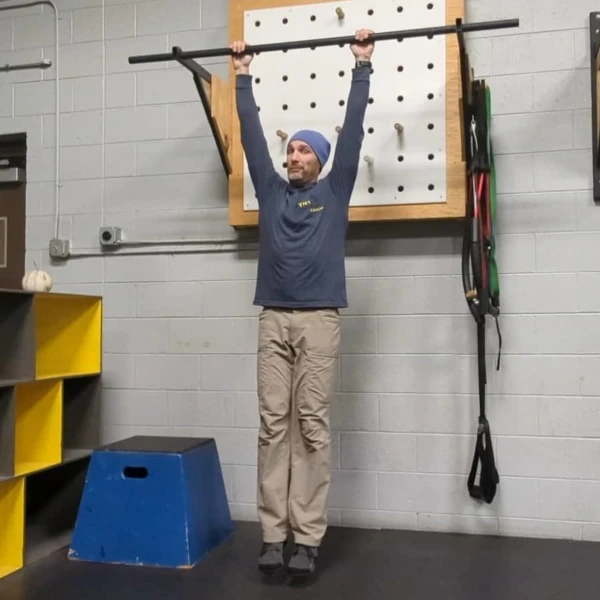
Like farmer carries, dead hangs may not appear to be particularly challenging at first glance. But your grip and lats (the big muscles that go from the mid-back into the armpits) will say otherwise.
On that note, the lats are among the main “protectors” of the shoulders in this exercise and are where you should focus your attention. Which leads me back to the most important of the three steps for performing the movement: pack those shoulders. (Hopefully you’re catching on to the importance of developing that skill.)
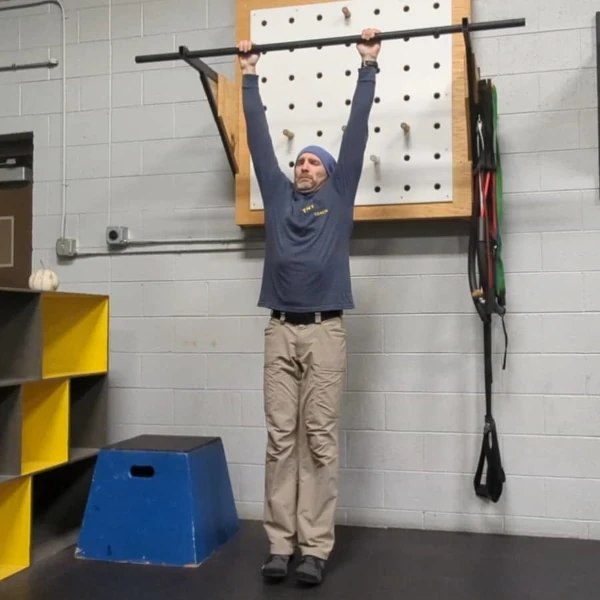
In this case the dish towel idea doesn’t make much sense because your arms are overhead. So instead, remember that shoulders are “ear poison” and should be kept as far away from them as possible. (Seriously though, elevated shoulders are a threat/fear response and not what we’re after if strength development is the goal.)
To see what I mean, compare the image above (good) with the one below (not so good).
You can learn what the good position feels like before dangling from a bar by doing the following:
- From a standing position, raise your arms overhead with your palms facing backward.
- Shrug your shoulders, bringing them closer to your ears.
- “Anti-shrug” your shoulders, pulling them away from your ears.
Feel that tension in the back corner of and below your armpits during that final step? Those are your lats. And, for safety’s sake, they should be engaged before you lift you feet off the ground on a dead hang. (At least until you can knock off a few unassisted pull-ups… at which point you can play around a bit with various degrees of engagement.)
If you’re not quite strong enough to keep your lats engaged when you attempt to hang, you have two options. The first is to continue doing farmer carries for awhile. The second is to partially support your body weight by keeping your toes on the ground, like this:
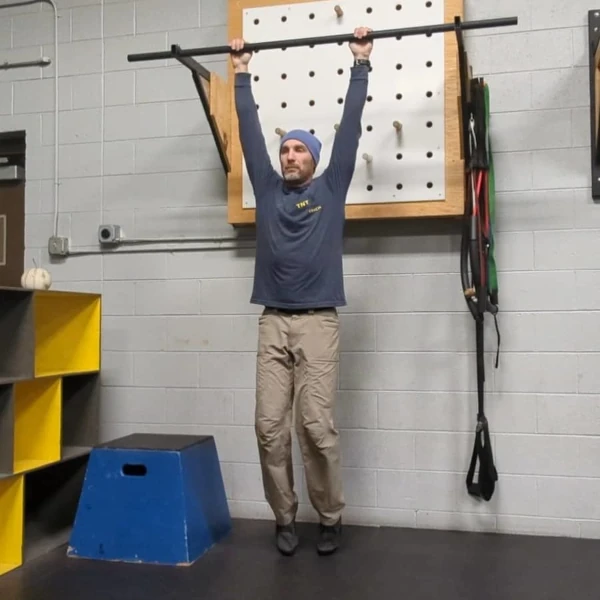
Whether or not you partially support your weight with your feet, a good starting plan is 2 – 5 sets in which you hang for about half the time that you could hang if you were to go all-out. Rest for a few minutes between sets to remain as fresh as possible, and perform 1 – 3 sessions per week.
Of course, improving your hanging strength opens the door to a variety of other useful (and fun) exercises like flexed-arm hangs, pull-ups, hanging knee/leg raises, pegboard climbing, and “skin the cat”, among others.
So if you need more excitement than just hanging around, there’s plenty of fun to anticipate!

Putting it into practice
If you’re currently recovering from a shoulder injury (and have medical clearance to train!) or have otherwise unhappy shoulders, farmer carries are a good place to start.
And if your shoulders are in relatively good health, then both farmer carries and dead hangs can be easily added to your existing routine with minimal fuss.
In either case, start with the rep/set/session recommendations above. Before too long you’ll be surprised at how good your shoulders will feel.