
In last week’s tip I attributed the development of some skills and abilities that are relatively easy for me now, but which are not generally easy, to two main factors: years of practice and getting “bonus” practice by focusing on fundamentals common across numerous exercises.
Then I discussed the fundamental of shoulder packing and how it relates to both swings and get-ups, two seemingly dissimilar exercises.
This week’s tip continues the comparison between swings and get-ups in relation to a second fundamental: torso bracing.
More than abs or core
I use the term torso here instead of abs or core because the movement pattern is more involved than the latter two terms imply.
To many people abs mean just the superficial belly muscles, while core might be expanded to include the obliques (on the sides of the torso) and perhaps the muscles of the lumbar spine (i.e. lower back). But what I’m describing here also includes the tailbone and pelvic floor; upper back, chest, and shoulder musculature; and even the head.
Let’s get the general feeling with five simple steps:
- From a standing position with a shoulder-width stance, lock your knees and engage your glutes and pelvic floor muscles like you need to visit a restroom but have ten more minutes in the car.
- Engage your abs like you’re bracing for a punch. (I’m sure a spouse, sibling, or friend would be willing to help with this if you ask politely. 😉)
- Pack your shoulders using the dish-towel-in-the-armpit idea from last week’s tip.
- “Get taller” through the crown of the head. Imagine a proud moment, but keep your chin down and don’t lose that ab engagement!
- Shift your focus to your feet. If most of the weight is in your heels, lean forward slightly so your weight is distributed roughly evenly between your toes and heels.
Notice that strong, I-could-carry-anything feeling? That’s torso bracing at work.
Hopefully obviously, it’s not what you should be doing when stretching. In that case you can and should be able to bend your spine from side-to-side as well as flex (round forward), extend (arch backward), and twist. But when you’re lifting anything heavy, from a weight in the gym to your friend’s couch, torso bracing will keep you safer — especially your lumbar spine — and make you stronger.
Application to swings & get-ups (and other exercises)
As I mentioned in the hinge vs. squat tip, moving between spine flexion and extension under load is a bad idea. At best, doing so will leave you with a back that just hurts. At worst, you could experience injuries to the discs.
So torso bracing (with some minor tweaks) is a requirement when doing any type of squat or hinge exercises such as swings, snatches, cleans, jerks, and any variation of squats or deadlifts.
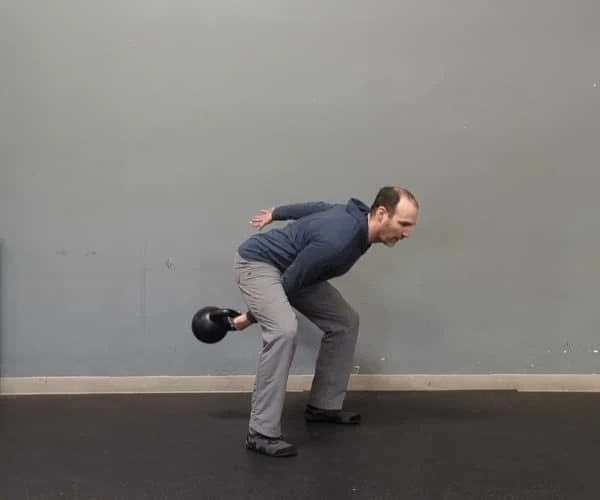
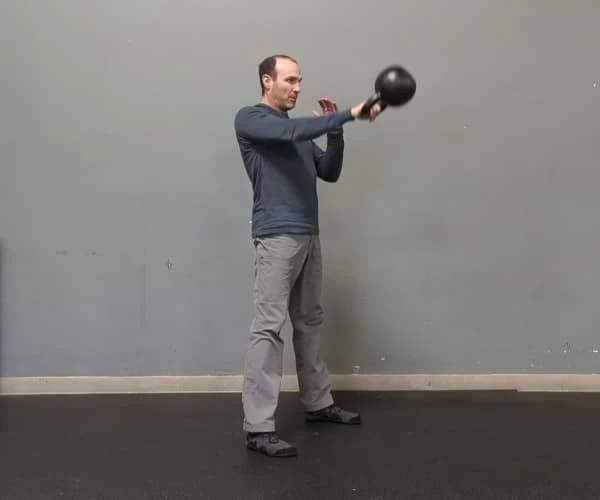
What are the minor tweaks? Namely the engaged glutes, which need to disengage when the hips flex, and the neutral neck, which may move into slight extension at the bottom position of the exercise.
Note those tweaks in the following image of the bottom of the swing, as well as the absence of those tweaks at the top of the swing.
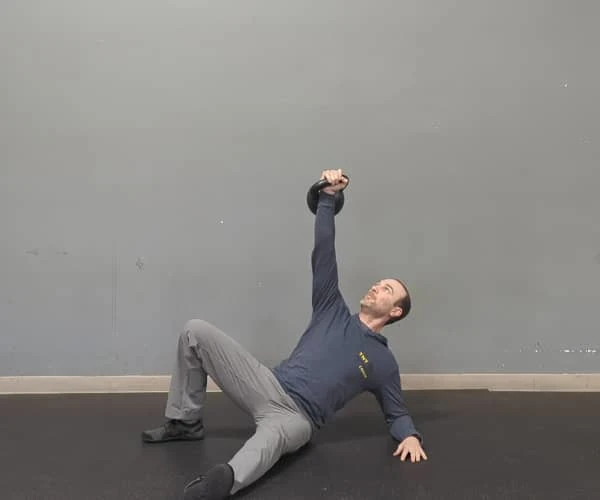
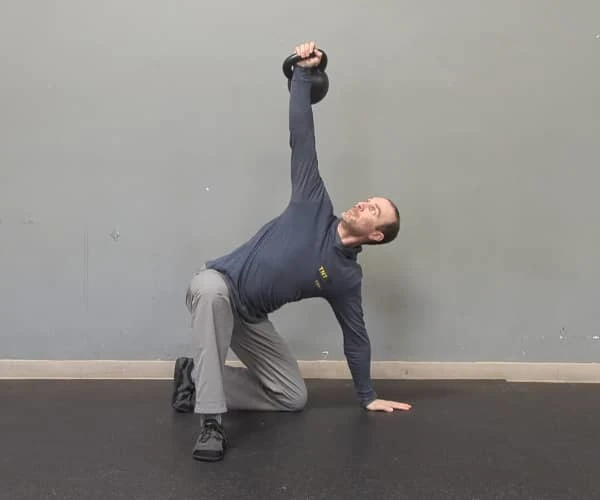
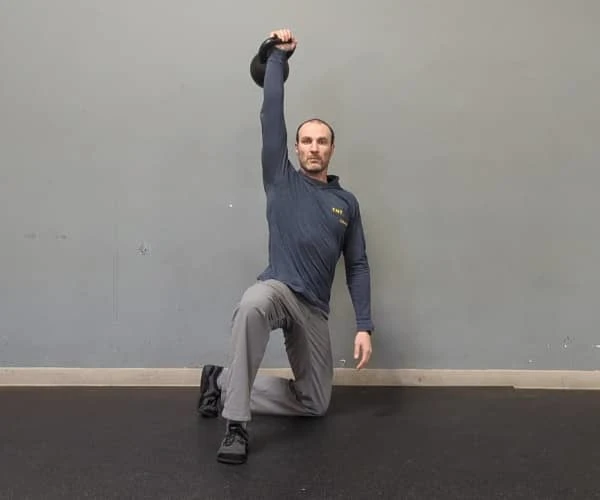
While that all hopefully makes sense, you might still question how this applies to the get-up since the exercise progresses through various planes of motion, with the first part often described as the “punch and crunch“.
The simplest answer I can give is: The get-up is not a sit-up (i.e. crunch).
In a sit-up, the first movement is usually spine flexion pulling both shoulders off the ground. Then the muscles in the front of the hips engage pulling the rest of the torso off the ground.
But the get-up is different. Instead of spine flexion, the movement should begin with a torso brace. Then pushing into the ground with the “working” foot—that is, the leg on the same side as the hand holding the weight—and “pulling” with the opposite elbow will pull the torso off the ground.
Putting it into practice
As I mentioned with shoulder packing last week, torso bracing should be performed to some degree whenever you lift a weight heavier than your phone.
To get in the habit, quickly practice the five steps above prior to lifting anything heavy at the gym (or buying groceries, water softener salt, or dog food).
And as a bonus practice, review the “pinch hinge” drill from the hinge vs. squat tip. I’ll bet that if you do both, you’ll instantly be able to lift a heavier weight and your back will feel better doing so.