
Next to the water filter at the gym hangs a giant kettlebell cutout covered in handwritten thank-you notes from members. It was given to me as a gift in mid-2014 at the two-year anniversary of having moved the gym into the space we still train in today.
After 12 years, the ink has faded enough that a number of the messages are getting hard to read. But everyone had signed their note, and I can still easily picture each individual. (Some are still members.)
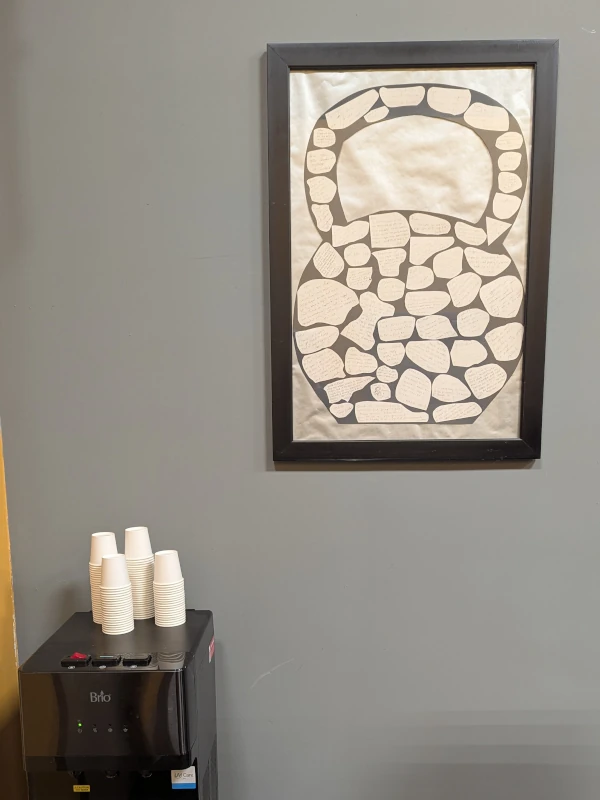
One of my favorites reads:
Week 6! May not mean much to most people, but it means so much to me! Thank you for the supportive, motivating atmosphere and for a routine I can stick with!
As the note says, six weeks might not sound like much. But the woman who wrote that had never stuck with an exercise program for more than a week or two in her entire life—her own admission—so it carried more weight (pun intended) than it might seem on the surface. And that was only the start—she ended up training here for just over eleven years (through two pregnancies, no less) before moving on to other things.
It’s Thanksgiving week, and today’s tip will be about gratitude for the fifth year in a row. The previous four covered keeping a gratitude journal, mental subtraction, being grateful for your problems, and gratitude as an attitude.
All four past tips were about gratitude we can practice privately, in our own heads or notebooks. This year’s is about the kind someone else gets to read.
Thank-yous land bigger than we expect
In 2018, psychologists Amit Kumar and Nicholas Epley published a series of experiments in which people each wrote a letter to someone who had made a difference in their lives. Before the letters were sent, the writers predicted how the recipients would react. Afterward, the researchers asked the recipients.
As it turned out, the writers guessed wrong, and in the same direction every time. They underestimated how happy—and overestimated how awkward—the letter would make the recipients feel. They also worried far more about expressing themselves well than the recipients cared about it. (Recipients rated the letters as considerably more articulate than the writers expected.)
Beyond simply being interesting findings, the writers’ incorrect guesses were important because those who expected their thanks to be awkward, or who doubted they could find the right words, were less likely to want to express their gratitude.
In other words, we seem to hold back on thank-yous because we think they matter less than they do—and that we might “mess up” when we express them.
Which may partially explain why a thank-you card another member gave me a while ago opened with an apology for being late (she’d meant to write it more than a year earlier). The envelope also asked me not to judge her writing or penmanship too harshly. But as you might expect, it didn’t mean any less to me for being “late”—can it even be late if it’s unexpected?—and I couldn’t have cared less about the penmanship quality.
The one I can’t send
Of course, I have my own list of thank-yous I’ve been slow to send. Near the top of it is one to Ann.
From college years into my early 30s, I played on a couple local baseball teams each summer. Shortly after my first kettlebell certification (back when I carried a kettlebell around in my car), I showed a few things I’d learned to some of the guys after one of our games. Ann, who was dating (and later married) our center fielder, came over afterward to ask what was going on and whether I’d show her too. She liked it enough that she asked if I’d run a class for her and some of her girlfriends.
That class is, more or less, how TNT started.
I’d like to think I would have started the gym eventually anyway. But I honestly can’t say for certain. What I can say is that my life is immeasurably different now than it otherwise would have been, in a variety of ways, and I’m forever grateful.
Ann passed away a few years ago, and I’m relatively certain that I never told her any of that. I’d like to think she knew anyway. But I can’t say that for certain either, and I’d much rather have told her while I could have. She’ll never read this, but some of the people who loved her might. So for them: she’s a big part of why TNT exists.
Putting it into practice
This week, consider who has made a difference in your life, specifically to your health or training: the friend who dragged you to your first class, the training partner who keeps you showing up, or the spouse who handles the kids so you can get to the gym before work.
Then write them a few sentences. Say what they did and what it changed for you. Be specific. (The notes on that kettlebell that have stuck with me the longest are the ones that name exactly what changed.) And don’t worry about getting the words right. Based on the research, the person reading it won’t be grading your writing.
If nobody comes to mind right away, start with the person you assume already knows how you feel. They probably don’t know as well as you think.
Then send it—or say it out loud the next time you see them. I suspect it will be more impactful than you expect, and you’ll feel pretty good about it too.
Happy Thanksgiving!