
It’s a few days before Thanksgiving and, staying consistent with the past few years’ theme, today’s tip is about gratitude. If you’re new to these tips or simply want to review from the beginning, I’ve covered:
- My experience with a specific gratitude practice
- Taking a different perspective on gratitude
- Being grateful for challenges because they help us grow
This year I’ll cover how gratitude fits into and influences our identity and how that impacts other areas of our lives.
Gratitude isn’t just a feeling
Most people think that gratitude is just a feeling that naturally occurs following some type of good event. And, of course, it is that. But research suggests it’s also something bigger: a way of being that precedes events and influences who we become.
In his book Thanks!, Robert Emmons draws parallels between research done on happiness and his own research on gratitude.
On the happiness front, he discusses a study in which researchers asked people to hold a pencil either sideways between their teeth or outward between pursed lips, which made them form a sort of smile or frown, respectively.
The researchers found that “when people mimicked the facial expressions associated with happiness, they felt happier—even when they did not know they were moving ‘happy muscles’ in their face.”
And gratitude works the same way.
On the gratitude front, he points to results from his own research in which people were divided into three groups and asked to keep a weekly journal of five things that had recently happened (control group) or for which they were either grateful (gratitude group) or displeased (hassles group).
After ten weeks, he and his fellow researchers found that “participants in the gratitude condition felt better about their lives as a whole and were more optimistic about the future than participants in either of the other control conditions. To put it into numbers, according to the scale we used to calculate well-being, they were a full 25 percent happier than other participants.”
Both of these experiments are important because they demonstrate that our feelings are as much a result of our preceding actions as they are natural emotions that follow positive events. And as Emmons points out elsewhere based on his follow-up research on gratitude and a review of the scientific literature on happiness, people who are happier and more grateful generally experience better outcomes at work (e.g. productivity, income), in relationships (e.g. longer and more satisfying marriages, more friends), and with physical health (e.g. less pain, lowered stress, more energy).
Feeling vs. being
Of course, even though gratitude and happiness are outcomes of our actions, they are also still feelings which naturally occur after experiencing positive events and disappear after experiencing negative ones. So how does gratitude come into play during those times when life slaps us in the face?
Emmons points out that it’s absurd to think we should feel grateful when something unfortunate happens to us. But he then reiterates that gratefulness isn’t just a feeling but also “an attitude, a chosen posture toward life that says, ‘I will be grateful in all circumstances'”.
Choosing to be grateful—even when we don’t feel it—buffers the negative emotions that we are feeling and helps us to deal with and be strengthened by the adversity.
And if we do that consistently enough, we…
Create a grateful identity
In Atomic Habits, James Clear says:
The more you repeat a behavior, the more you reinforce the identity associated with that behavior. In fact, the word identity was originally derived from the Latin word essentitas, which means being, and identidem which means repeatedly. Your identity is literally your “repeated beingness”.
Just like any other habit, the longer and more consistently we practice the act of gratitude, the more we’ll view ourselves as being grateful.
The more we view ourselves as being grateful, the more likely we’ll be to consistently complete other actions that improve our odds for success throughout other areas of life.
The more consistently we experience success throughout life, the more grateful we’ll actually feel more often.
And that is not only good for us as individuals; it spreads ripples into the world because identities are resilient and attitudes are contagious.
Putting it into practice
Thanksgiving is a time of the year when expressing gratitude—often just before a meal with friends or family—feels easier. Certainly continue that practice if it’s something you already do.
But remember that both feelings and identity are cultivated by repeatedly acting. So let’s also use this year’s holiday as a prompt to do just that.
Here’s a picture of an alarm that I’ve added in my phone: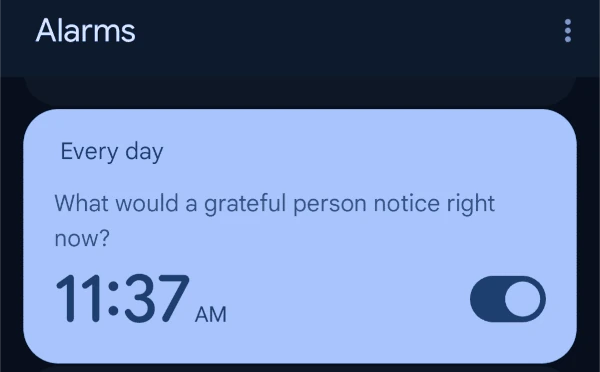
It’ll serve as a daily reminder, at a somewhat random time which I might not otherwise notice, to both be grateful and to continue cultivating my identity as a grateful person.
I hope that you’ll join me in the practice.
Happy Thanksgiving!