
Last week’s tip began a short series on behavior change by comparing a couple research studies and discussing the idea that our motivation and subsequent willingness to take any action is correlated to the nature of our reason for taking the action.
This week’s tip is meant to act as a bridge between understanding why we may want to change certain behaviors (last week’s idea) and an actual strategy that makes our behavior change efforts more likely to succeed (next week’s idea). It all revolves around inertia and the size of the action or behavior that we want to change.
The bigger they are, the harder they… are to change
Have you ever noticed the common human tendency to finally become fed up with some condition or action and then try to change a bunch of things all at once? You know, things like going from eating whatever you want whenever you want to attempting to follow a strict diet plan (e.g. Paleo, Whole30, vegetarian, intermittent fasting), or going from a sedentary desk job and zero weekly exercise to jumping into some time- and effort-intensive program (e.g. the opposite of this plan).
While making such changes aren’t guaranteed to fail, they often lead to minimal long-term behavior change unless we have both an iron will and significant reasons to stick with them. (Ever heard of David Goggins? He’s impressive, but most people—myself included—don’t necessarily want to emulate his use of willpower.)
But as you almost certainly know from experience, willpower is constantly fluctuating based on a multitude of factors including sleep, stress, hunger, time of day, outside requests (from family, co-workers, friends), and other responsibilities. So attempting to make major behavior changes under the assumption that your willpower will always be high is a shaky strategy, at best.
If sustainable results (i.e. long-term behavior changes) are what we’re after, then choosing small behaviors which require minimal willpower are the way to go.
How small?
Very small… extremely small… ridiculously small. So small, in fact, that you think it’s unlikely to produce any effect. Some might even call it tiny.
As BJ Fogg (a behavior scientist at Stanford) points out in his book, Tiny Habits, the important aspect of these actions is not to necessarily produce results themselves. Rather, it’s to train our brains to prioritize and actually do the actions that we think are important. Along the lines of Newton’s first law of motion, which states that objects in motion or at rest tend to stay in motion or at rest unless acted upon by another force, taking these single, tiny actions breaks us out of our inertial tendencies to not change.
If we decide to do more in the moment after completing our tiny action, great. If we decide to not do more, that’s great too. The point is that we still did something. That something is likely to lead to doing more (and doing it more consistently) at some point in the future. And that consistency and extra activity is what leads to long-term behavior change and, more importantly, the results we’re after.
Here’s the simple acronym, diagram, and description that BJ uses to illustrate the idea:
B = MAP
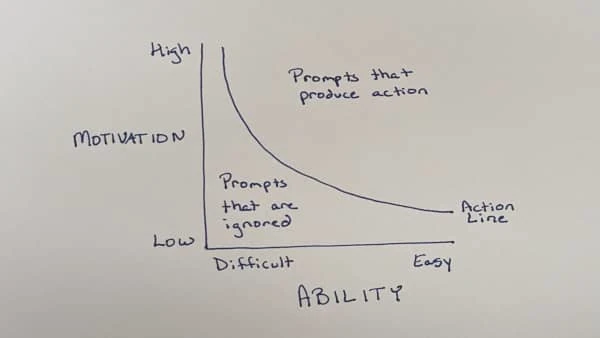
A behavior happens when the three elements of MAP—Motivation, Ability, and Prompt—come together at the same moment. Motivation is your desire to do the behavior. Ability is your capacity to do the behavior. And prompt is your cue to do the behavior.
As I mentioned above, our motivation fluctuates on a regular basis. So when we consider specific actions that we might take for our behavior change endeavor, we want to make sure they fall on the easy end of our ability scale. Because the actions are so easy, we’re almost guaranteed to do them regardless of our motivation level when the related prompt occurs.
On the other hand, actions that fall on the difficult end of our ability scale will be hit-or-miss depending on whether our motivation is high or low in the moment of the prompt. And in relation to behavior change, taking a specific action only when we feel like it is habit sabotage.
Putting it into practice
Consider the healthy behavior that you came up with last week and had wanted to add into your life. Now consider a few tiny, related actions that you could implement regardless of your motivation level.
A few examples might include:
- Floss regularly (behavior). Floss one tooth (action) before brushing at night (prompt).
- Get eight hours of sleep (behavior). Go to bed five minutes before normal bedtime (action; prompt = time).
- Exercise more regularly (behavior). Do two push-ups (action) every time you walk into the kitchen (prompt).
- Eat less junk food (behavior). Eat one baby carrot (action) before eating your favorite snack (prompt).
Hopefully this seems simple enough. Still, there are three other conditions (and one more acronym) that will help you increase the odds of implementing and continually developing your new behavior(s). I’ll cover that next week.