
One of the last “core” classes that I took in college was called World of Ideas. The curriculum included a high-level overview and discussion of major ideas from philosophical, religious, and secular sources.
As part of the final, we each had to write a paper on what we thought constituted “the good life”. I can distinctly remember sitting in front of my computer struggling to refine my ideas; everything that I started to write ended with “but it depends”.
I didn’t struggle for lack of ideas about what I thought constituted a good life or my good life but rather the good life. As I imagined a variety of potential “good lives”, I was always able to think of some condition that disqualified any specific detail from being included in a life that would be good for everyone.
What I should have written about were concepts and principles that would produce a good life when idiosyncratically expressed. In that case, the details would look different for everyone while also being conceptually similar.
As it is, I don’t remember specifically what I wrote. It probably just included what I thought might constitute my good life and also what would net me a good grade. Because obviously good grades are a requirement for a good life (note the sarcasm).
Fast forward 20+ years, and I’m about halfway through a similar course—which I highly recommend—covering exactly the ideas I didn’t know enough to write about for that college final: concepts and principles, gathered from a variety of both great historical figures and modern scientists and researchers, that produce an idiosyncratically expressed “good life” when implemented.
And that brings me to the idea behind this week’s tip. Yesterday I was reading some course material about leadership and was reminded of two ideas related to success—which, we can probably all agree, is a necessary component of any good life:
Success requires a price
The first comes from How to Fail at Almost Everything and Still Win Big—which I incidentally read a few years ago—by one of the great modern thinkers, Scott Adams. (If you’re thinking, “Um, isn’t Scott Adams the creator of Dilbert?”, you’d be correct. And I’m being reasonably serious about his being a great modern thinker. Yes, Dilbert is pretty ridiculous. But to create such a highly successful comic as witty as Dilbert, you have to have a fairly solid grasp of certain psychological and philosophical principles. In any case, the book is entertaining and insightful.)
Adams writes:
One of the best pieces of advice I’ve ever heard goes something like this: If you want success, figure out the price, then pay it. It sounds trivial and obvious, but if you unpack the idea it has extraordinary power.
I know a lot of people who wish they were rich or famous or otherwise fabulous. They wish they had yachts and servants and castles, and they wish they could travel the world in their own private jets. But these are mere wishes. Few of these wishful people have decided to have any of the things they wish for. It’s a key difference, for once you decide, you take action. Wishing starts in the mind and generally stays there.
When you decide to be successful in a big way, it means you acknowledge the price and you’re willing to pay it.
Whether your definition of “success” relates to a career, creativity, relationships, finances, parenting, fitness, or any other endeavor, there are certain things you’re going to have to do to achieve that success. As Adams points out, that seems obvious.
Occasionally, the challenge that arises is figuring out what those things are. But the bigger challenge, as the above quote hints at, is having the willingness to deal with the discomfort that inevitably comes from actually doing those things.
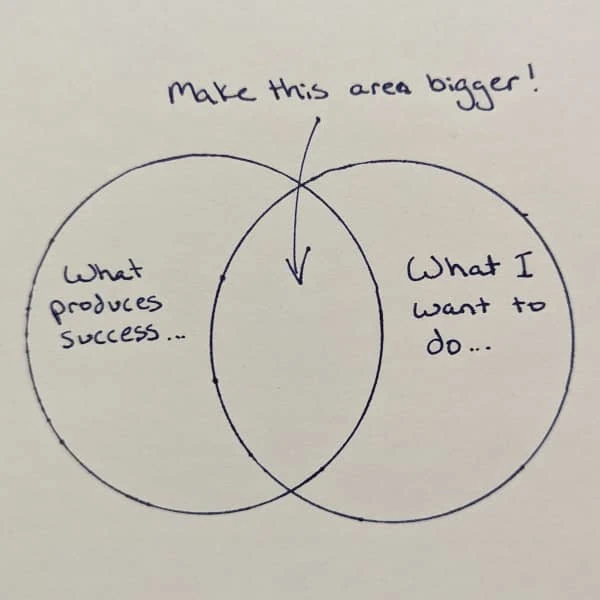
Which brings me to the second idea that we need to embrace in order to be successful (again, however you may define that term).
I love PUH (pronounced “poo”)
This idea comes (in the Coach program) from a distillation of an idea by clinical psychiatrist, Phil Stutz. (BTW, if you’re looking for a cool movie, check out the Netflix documentary by Jonah Hill featuring Phil and aptly titled Stutz. ← There’s a trailer at the bottom of the page if you click the link.)
PUH, as you may have guessed, is an acronym. The letters stand for: “Pain”, “Uncertainty”, and “Hard work”.
In the documentary, Phil says that we’ll “never be exonerated from pain, uncertainty, and hard work” as long as we’re alive and that we need to embrace them if we want to lead a fulfilling (i.e. “good”) life.
Stated another way: Learning anything new requires that we do something that is at least a little out of our comfort zones. Getting out of our comfort zones is, by definition, uncomfortable. If we do uncomfortable things (which involve some amount of pain, uncertainty, and hard work), then we have the possibility of learning and growing. If we don’t do uncomfortable things, then we’re going to stagnate.
Since I’m fairly certain we can all agree that stagnation rarely leads to a good life, then learning to embrace discomfort (i.e. pain, uncertainty, and hard work) is something that we must do if we want something better for ourselves and those around us.
So, I love PUH! How about you? 🙂
Putting it into practice
Lets apply this to fitness.
First, what does your idiosyncratic expression of fitness success look like? Does it include having six pack abs? Or being able to run a mile in a certain time? To weigh a certain amount? To climb a mountain, do a pull-up, or improve your golf game?
Really, get clear on that. If you’re not, it’ll affect your motivation. And if you are, it’ll provide you with inspiration (among other benefits).
Now that you’re clear on what you want, what steps do you need to take to achieve it? What’s its price? Have you been paying it, or is there more (or something different) you could do? Have you been shying away from doing that? If so, does the reason fall into any of the pain, uncertainty, or hard work buckets?
In any case, run what you come up with through the WOOP framework—you’ve already done the “W” and perhaps the second “O” parts. Say to yourself, “I love PUH”. And then get to work (and play)!