
One of the most fascinating moments for most people participating in a StrongFirst kettlebell certification occurs during the section covering the military press.
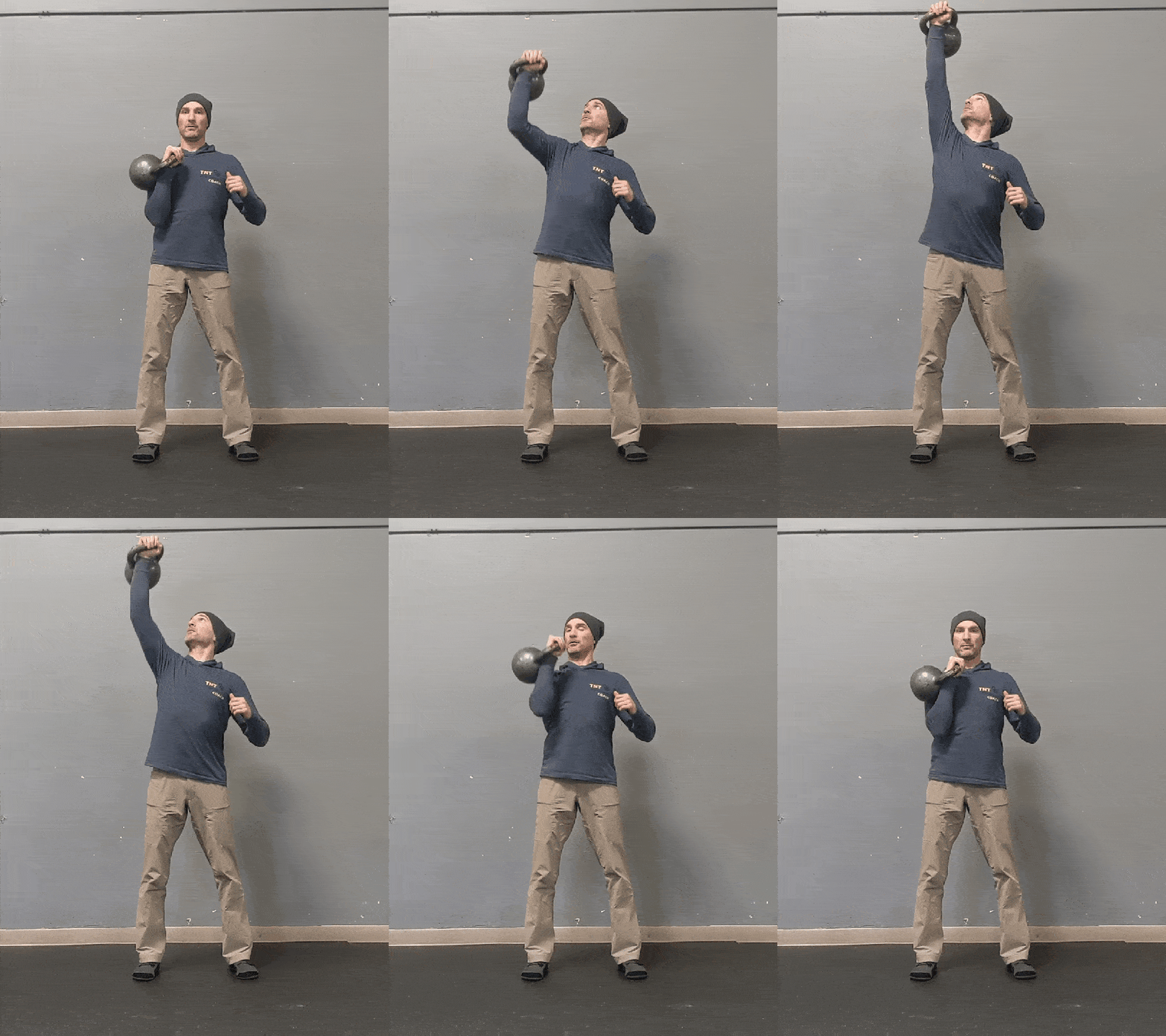
Toward the end of the section, participants are instructed to grab a kettlebell one size larger than the heaviest weight they are currently capable of pressing.
When they’re subsequently asked to attempt to press this supramaximal weight while applying the principles they’ve just learned, more than a few return expressions laced with skepticism. And, yet, roughly a third of them—occasionally more—end up successfully pressing the weight they’ve selected.
Now this wouldn’t seem all that surprising if the participants were new to lifting because making significant progress quickly during the beginning stages of almost any activity is common. What makes the moment so fascinating, however, is that most individuals who attend these certifications have been weight training for years (or decades). And most of them are already quite strong and generally aware of their limits.
So, ultimately, the “experiment” serves to illustrate the effectiveness of the principles that had just been taught.
Squeeze for Strength
One of those principles is ridiculously simple: immediately before pressing, squeeze the handle of the kettlebell with the hand gripping it while simultaneously making a tight fist with the other hand.
The reason this works is due to a concept called muscle irradiation. This describes the phenomenon of contraction in one muscle group causing activation of other muscle groups in close proximity.
When you squeeze the handle of the kettlebell, the muscles in your forearm obviously “turn on”. But so do other muscles in your upper arm (biceps, in front, and triceps, in back), shoulder (deltoids and many smaller stabilizing muscles), chest (pecs), back (lats), and even abs.
All those muscles contracting simultaneously do a specific job (movement or stabilization) toward applying force against the kettlebell, making it feel lighter than it would have felt had only some of the muscles contracted.
And then we also have the hand on the non-working side. The point of squeezing that hand into a tight fist is making use of the tendency of our hands to mimic each other. If you’ve ever tried to rub your head and pat your belly at the same time, you know what I mean. Or is it pat your head and rub your belly? Well either way, both are challenging and illustrate the point.
Squeezing the hand on the non-working side into a fist causes the hand on the working side to squeeze even tighter, which causes all the other muscles on that side to contract even tighter, which causes the kettlebell to feel even lighter.
And all of that means you’re able to:
- Lift a heavier maximal weight.
- Lift a submaximal weight for more reps.
Which makes you stronger and expends more energy. (Although if energy expenditure and weight loss are your goal, you still have to remember that you can’t out-snatch a donut.)
Putting it into practice
This squeeze-the-hands strategy will make you stronger on just about any grinding lift—a movement that requires constant force production. For ballistic lifts—fast movements like swings, jerks, snatches, and cleans—you’ll generally want to keep a loose grip for a variety of reasons, which I’ll save for another day’s discussion.
If you’re currently a TNT member, you’ll be able to apply this detail over the next few days when you attempt a new max for the get-up.
When you set up, grip the kettlebell as you normally do. Then at any point during the lift when you begin to feel a bit shaky or uncertain, squeeze the handle tightly and continue on. Doing so won’t exactly make the weight feel light. But it should make the weight feel lighter and enable you to advance farther into the lift (and hopefully complete it)!
If you’re not currently a TNT member, you’re obviously a bit more on your own on this one. When you lift something heavy(ish) this week, squeeze the handle or bar just as you begin the movement’s concentric phase—the “hard” part when you lift the weight as opposed to lower it.
If you’re lifting a weight that isn’t extremely heavy, you probably won’t notice much of a difference on the earlier reps of any given set. In fact, don’t even apply the strategy to those reps because you don’t need the extra umph yet. When you will notice a difference and should apply the strategy is closer to the end of your set or session, particularly if you’re trying to eek out one last rep.
In any case, the strategy is as effective as it is simple. Apply it, and enjoy its immediate effects.