
Health and fitness can seem rather confusing considering all the information floating around on the Internet today. Celebrities, athletes, and Instagram “influencers” are constantly promoting a plethora of diets, supplements, workout programs, and “beauty” creams across all types of media from television to magazines to social media platforms.
Achieving above-average health and fitness doesn’t have to be complicated though. In fact, implementing a few simple (although perhaps not “easy”) guidelines will help you improve both.
Here are six, in a general order of importance. (“General order” meaning that you could arguably juxtapose adjacent guidelines; but, generally, the top of the list is actually more important than the bottom.)
Sleep for 7–9 hours per day.
Research regularly shows that getting 5 or fewer hours of nightly sleep is linked to negative cardiovascular, metabolic, and mental health effects. Research has also shown that outliers do exist, but they’re relatively uncommon. On the flip side, 7–9 hours of sleep is linked to greater mental clarity, improved body composition & performance, and a stronger immune system.
Drink water, in ounces, equivalent to half of your body weight, in pounds, each day.
Water is used to regulate body temperature, produce hormones, and reduce your risk of kidney stones & urinary tract infections, among other uses. Other beverages (e.g. coffee, tea, juice) should be counted toward your daily water total, although non-calorie options are generally better for a variety of reasons.
This amount may actually be slightly high, but it’s an easy number to remember and you’ll still be in decent shape if you occasionally miss a little low.
Consume adequate nutrients from minimally processed foods daily.
This article & infographic from Precision Nutrition (PN) offers some helpful insight into foods that fall into less vs. more processed categories.
I’ll add/emphasize two more points:
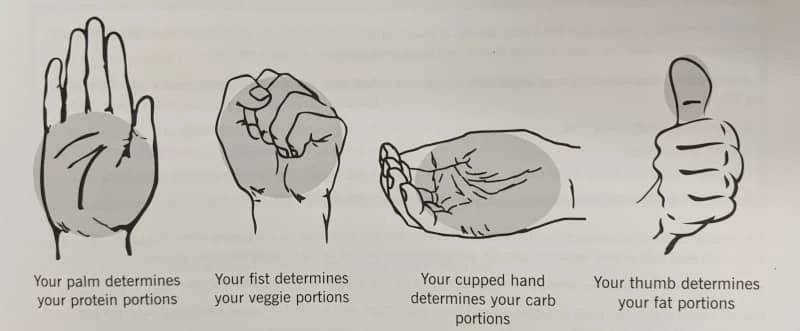
First, a good place to start to determine an “adequate” quantity is another PN recommendation of 6-8 servings of each category in the image below for men and 4-6 servings for women per day. Adjustments can be made to that recommendation based on a number of factors, but, generally, we’ve found that this suggestion aligns fairly closely to the calorie suggestions from BodPod tests.
Second…
Minimize processed foods, alcohol, and tobacco.
I’m not suggesting that you adopt a monastic diet by swearing off the likes of ice cream, bacon, or beer. I’m simply suggesting that you keep their intake to a minimum to more easily achieve your goals. They may taste good, but in excess they also wreak havoc on your sleep, waistline, mood, and performance.
Train (exercise) for performance. Aesthetics will follow, particularly if you emphasize strength development.
Lifting weights—barbells, kettlebells, dumbbells, sandbags, rocks, small children, or any other weight of your choice—increases strength (which makes life easier) and builds muscle (which typically makes any of us look better naked). But research and empirical evidence has shown that it also improves cardiovascular endurance to a reasonable degree.
Cardiovascular training, on the other hand, only improves cardiovascular endurance. That is still important, particularly for cognitive function and slowing the aging process. It just shouldn’t be the only exercise we do.
My typical minimum recommendation is one or two strength sessions per week and one conditioning session. More can certainly provide benefits, but starting small and increasing as fits your needs and lifestyle is a better way to develop consistency for a lifetime.
Enjoy an active hobby.
Weight and cardiovascular training can and should be at least somewhat enjoyable, but their main purpose is to improve specific physiological characteristics.
Active hobbies (e.g. golf, swimming, gardening, martial arts) also improve physiological characteristics, although usually to a lesser degree than intentional weight/cardio training. But they often provide a greater degree of stress relief, entertainment, and senses of anticipation & purpose. All good things when improved health & fitness is the goal!
Putting it into practice
Research typically shows that a small minority of Americans do all of the habits above regularly. In fact, the last number that I remember seeing was less than 8%.
If you do fall into that 8%, congrats! Just keep doing what you’re doing.
If you fall into the other 92%, it’s OK! Don’t feel like you have to add everything that you’re not currently doing into your routine. Instead, start small (as I always emphasize in this section of the tips).
Pick one of the items that you want to improve, and actually track that habit for a few days to determine what is normal for you. Then work to improve that habit, little by little, week by week until you’re satisfied with your progress. If you start today, you’ll be amazed at what you’ll have accomplished by the time the next New Year’s Resolution season rolls around.