
Rounding of the mid & upper back (thoracic spine) and stiff hips are the two most common restrictions that I see when someone walks through the doors of the gym for the first time. Neither restriction is particularly surprising; they’re typical results of sitting too much (welcome to modern Western society) and aging (none of us is getting any younger). And both restrictions are common underlying causes of pain or discomfort that appear in other parts of the body—stiff hips often contribute to lower back pain, and thoracic immobility often contributes to shoulder issues.
There are a ton of stretches, exercises, and other drills that can be used to improve mobility in either area. And, of course, there’s a time and a place for all of them. But if you’re looking for a single, time-efficient drill that targets both your hips and your spine, look no further than the Brettzel.
How to do it
Start out by lying on your side with your hips & shoulders stacked. If you’re just starting out, it’s good practice to also have a support for your head (e.g. towel, yoga block). As your mobility improves, you can possibly go without… but don’t feel like you have to.
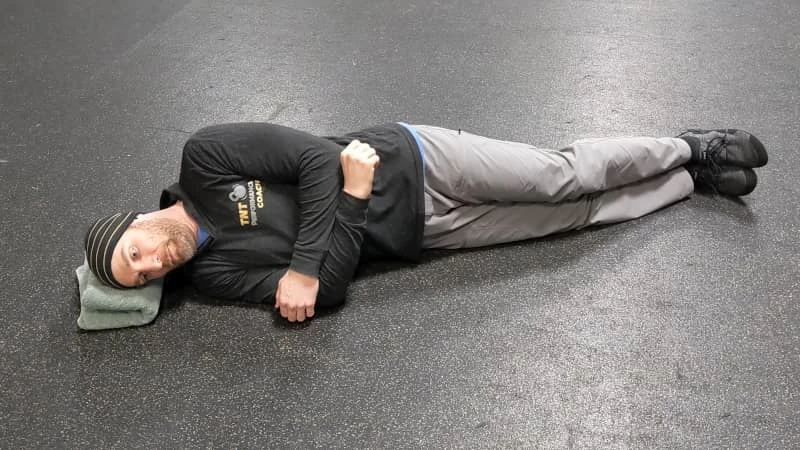
Bring your top leg as close to your torso as possible and hold it in place with your bottom arm. You’ll want to maintain stacked hips and a less-than-90-degree angle in the top hip throughout the movement, so make sure to hold the leg tightly!
Next, grab the toes of the bottom leg with your top hand. If you’re not flexible enough to grab your toes, wrap a small towel, exercise band, or yoga strap around your ankle, and hold on to that with your top hand. In any case, keep your bottom thigh in line with your torso. If you feel a stretch in the thigh of your bottom leg, you’re on the right track!
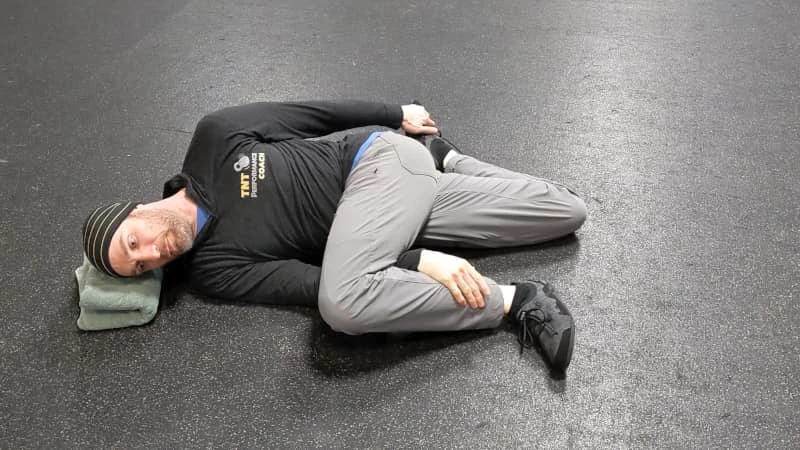
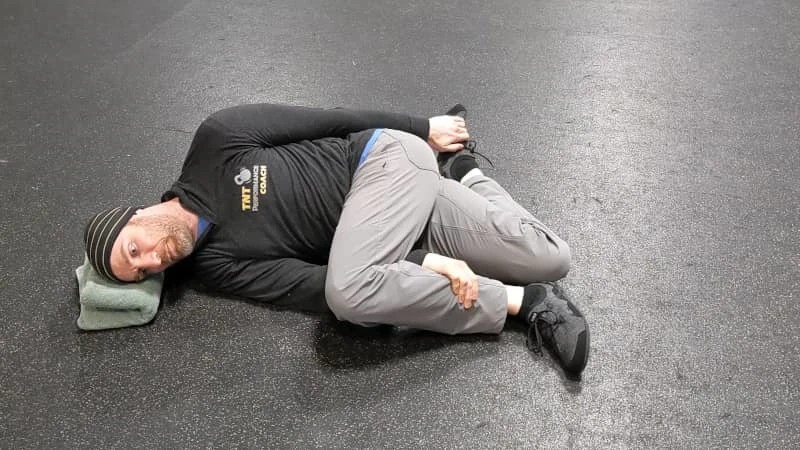
Finally, look over your top shoulder and rotate your torso to bring that shoulder closer to the ground while making sure that your hips remain stacked. You’re highly unlikely to be able to get your top shoulder to the ground. If you do, you likely tipped instead of rotated, and your hips are likely no longer stacked. Start over again, and make sure to keep those hips stacked!
At this point, it’s also important to breathe deeply. If you’re only able to take short “sips” of air because your torso feels like a wrung-out towel, come out of the rotation a little until you can breathe normally. You’ll find that your torso will naturally rotate a little more with each breath if you start with a rotation that you can easily maintain. On the other hand, wrenching your torso as far as your muscles can pull it won’t do you much good. We’re looking for a stretch, not a contraction! The rule of thumb is: if you can’t breathe in a specific position, you don’t own it.
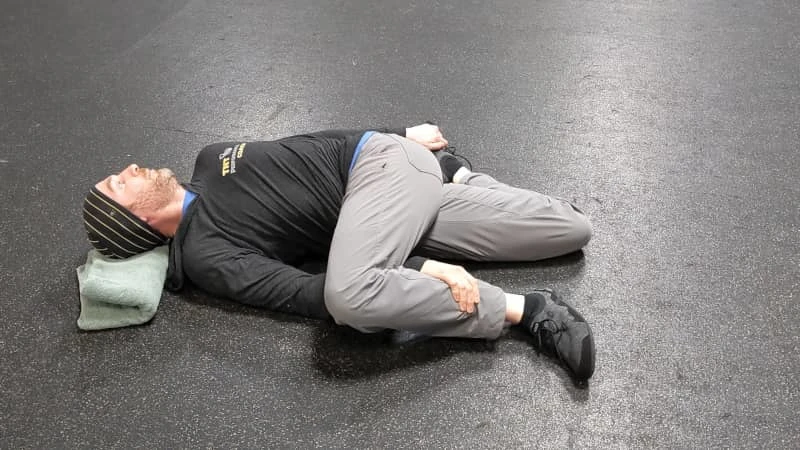
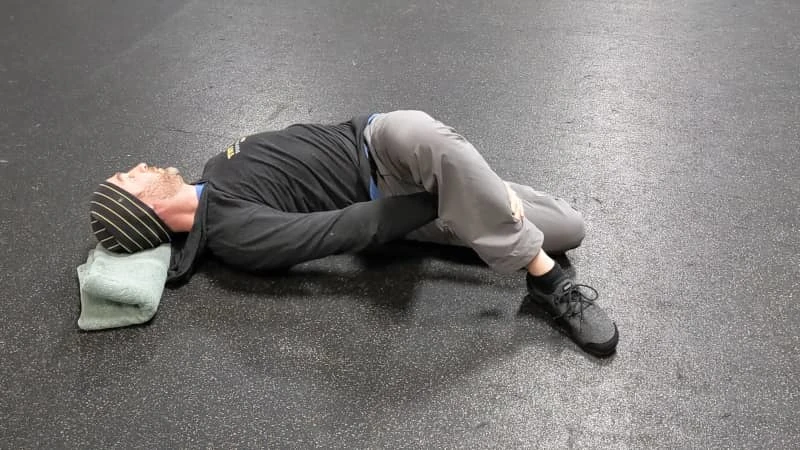
Hold the position (top picture) for 5-20 breaths before slowly rotating out of the stretch. Switch sides and repeat.
As an added bonus after some practice—perhaps months of it or longer—you may choose to grab the pinky-toes of the top leg and then straighten that leg for an extra stretch in the hamstring (back of the leg) and glute (butt). Again, make sure to keep that bottom leg in line with your torso! And breathe!
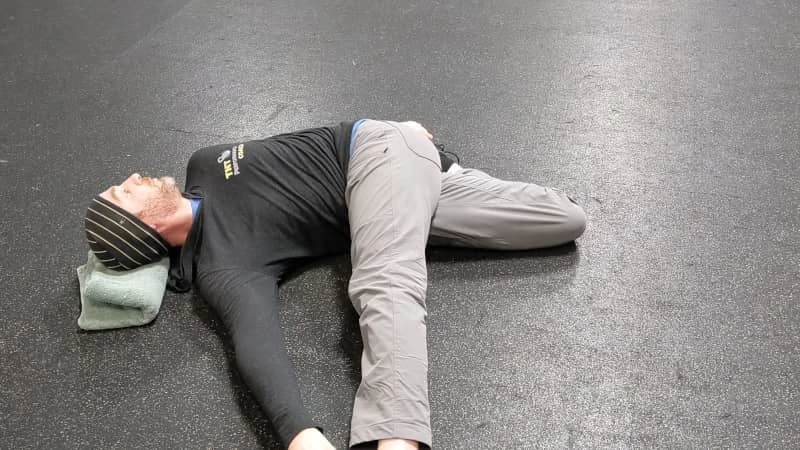
Putting it into practice
The Brettzel is a great addition to either the beginning or end of a training session. If the day’s training consists of any overhead work—barbell, kettlebell, or dumbbell military presses; snatches; jerks; getups—add it to the beginning of your session. If the day’s training consists of heavy bilateral work—powerlifts (bench, squat, and deadlift) or double kettlebell lifts—add it to the end of your session.
As I mentioned earlier, practicing the Brettzel daily is a useful strategy to combat some negative effects of sitting and aging. So on non-training days, practice it any time you feel tight—such as after sitting or hunching over a patient or computer for 8(+) hours—or to help you relax just before climbing into bed.